

Forces are the part of primary science children have the most experience of. Everyone has pushed a swing, kicked a ball and dropped things. Because it is so familiar, children arrive with their own explanations already in place: heavy things fall faster, a ball stops because it runs out of force. Teaching this topic is not filling an empty head; it is letting children see evidence that contradicts what they already believe.
Forces sit in the physical science strand of the 2017 revision of the Thai core curriculum. In general, Grade 3 introduces contact and non-contact forces and magnets, Grade 4 focuses on gravity, weight and mass, and friction and resultant force usually come in the following grade. Check the textbook your school uses and pick the experiments below that match the chapter you are teaching. Every experiment uses things you can find in a classroom or at home.
Key ideas to be clear on first
- A force is a push or a pull. Forces can make an object start moving, stop, speed up or slow down, change direction, or change shape.
- Some forces need contact, such as a hand pushing a table. Others act without contact, such as gravity and magnetism.
- Earth's gravity pulls every object towards Earth, which is why things fall when you let go. The pull does not switch off when an object is resting on a table.
- Weight is the force of gravity on an object, measured in newtons with a spring balance. Mass is the amount of matter in an object, measured in kilograms.
- An object with more mass is harder to get moving and harder to stop.
Experiment 1: Light bottle, heavy bottle, which lands first?
You need: two plastic bottles of the same size, one empty and one filled with water or sand with the cap screwed tight, two sheets of A4 paper, and a cushion or cardboard box to land on.
Ask children to predict which bottle will land first and write the class's predictions on the board. A volunteer holds both bottles at the same height, about shoulder level, and lets go at the same moment over the cushion. Repeat three times. Both bottles land at almost the same time, even though one is many times heavier.
Then try the paper. Drop a flat sheet at the same time as an identical sheet crumpled into a ball. The ball clearly lands first, even though both are the same paper with the same mass. What differs is the shape: the flat sheet is held back more by the air.
The conclusion to reach: gravity pulls everything down. Objects dropped from a modest height fall at about the same rate even when their weights differ, but air resists falling, especially for flat, light objects.
Experiment 2: A rubber band balance
You need: one rubber band, a plastic cup with two holes and a string handle, a ruler, and several objects of equal weight such as AA batteries or marbles.
Loop the rubber band over a pencil laid across two desks and hang the empty cup from it. Measure the band's length, then add the objects one at a time, measuring after each and recording in a table. Children see that the more they add, the more the band stretches, because Earth pulls the cup down with a bigger force.
Then introduce a real spring balance if the school has one, weigh the same objects and read the values in newtons. Tell children plainly that a rubber band balance is good for comparing more and less but not for reading numbers, because a rubber band does not stretch as evenly as a spring. It is a good moment to talk about why scientists need measuring tools they can trust.
Experiment 3: Empty box, full box
You need: two shoeboxes, a pile of books and a smooth floor.
Fill one box with books and leave the other empty. Have the same child push each box with about the same effort. Which one is easier to get moving, and which slides further? Then have a classmate gently stop each box with their hands as it slides towards them. Which is harder to stop?
Conclusion: the box with more mass is harder to change the motion of, both starting and stopping. Link it to real life: why does a fully loaded truck need a longer braking distance than a car, and why is a full supermarket trolley harder to stop than an empty one?
Experiment 4: A ramp and three surfaces
You need: a stiff folder or board propped on three or four books as a ramp, a toy car, a towel, a mat or rug, and a tape measure or ruler.
Release the car from the same point on the ramp onto three surfaces: a tiled or smooth floor, a mat, and a towel. Measure how far the car travels from the end of the ramp. Do three runs on each surface and record every one.
This is also practice in fair testing. The thing you change is the surface, the thing you measure is the distance, and the things you keep the same are the ramp height, the car and the release point. If a child pushes the car instead of letting it go, the result cannot be trusted; let the children explain why. If your class has met variables, use the terms independent, dependent and controlled variables.
The car travels the shortest distance on the towel, because the rougher surface resists motion more. A good follow-up question: if there were no friction at all, could we walk? Only with great difficulty, as on a wet, slippery floor or on ice. Friction is not always a bad thing.
Experiment 5: A magnet through paper
You need: a magnet, paper clips, a piece of card, and several things to test such as an iron nail, an eraser, a plastic spoon and an aluminium drink can.
Put a paper clip on the card and move the magnet underneath. The clip follows even though the magnet never touches it. That is a non-contact force, just like the gravity that pulled the bottles in experiment 1. Then have children test the other objects and sort them into attracted and not attracted. They will find that magnets do not attract every metal: the aluminium can stays put.
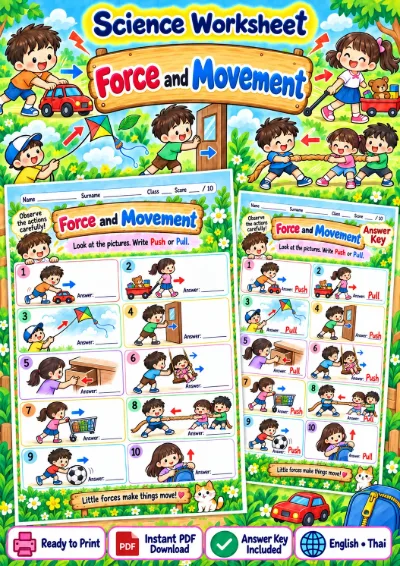
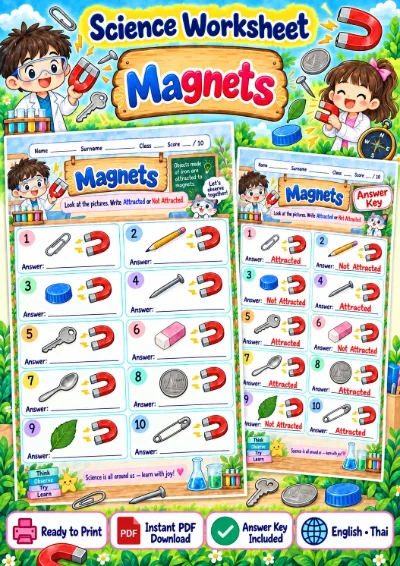
The magnets worksheet, where children write attracted or not attracted, works as an instant follow-up. For children just starting on forces, the push or pull worksheet shows everyday pictures, such as pulling a toy wagon, pushing a trolley and pulling a drawer, and asks which force each one is.
Common misconceptions and the evidence that fixes them
- "Heavy things always fall faster." Use experiment 1, and have children separate what is caused by weight from what is caused by air.
- "The ball stopped because it ran out of force." A ball does not store force inside it; it slows down because of friction from the ground and resistance from the air. The AR set on forces and motion asks this directly, with the options "the ball got tired" and "there was no force at all" for children who still hold the old idea. That is a good opening to ask why they think so.
- "Mass and weight are the same thing." In everyday speech we say someone weighs 30 kilograms, but in science the kilogram is a unit of mass. Ask what would change if an astronaut stood on the Moon. Their mass stays the same, but their weight drops to about one sixth of what it is on Earth, because the Moon's gravity is weaker.
- "Something at rest has no forces on it." A book on a table is pulled down by Earth all the time, but the table pushes up just as hard, so the book stays still. Have children hold a book on a flat palm and feel their hand pushing up.
- "Magnets attract all metals." Experiment 5 shows the aluminium can is not attracted.
Safety during the experiments
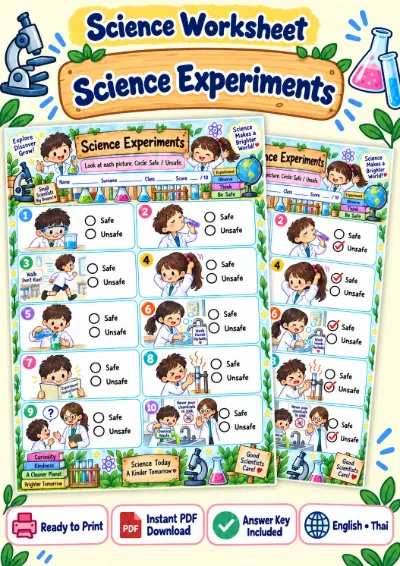
All five experiments are safe with a few ground rules set beforehand. Drop things from shoulder height onto a cushion only; no climbing on chairs or desks to drop from higher up. Screw the caps on water-filled bottles tightly. Push boxes where nobody is walking. Keep small magnets away from young children, who might swallow them. The worksheet on science experiments, where children circle safe or unsafe, is a quick way to go over the rules before a practical lesson.
Where AR games and the 3D lab fit in the lesson
Hands-on experiments should always come first, because children need to handle things, predict wrongly and see the evidence for themselves. Games fit best at the end of the lesson or the start of the next one, to check that the ideas have stuck.
The demo game Forces and Motion 3D Lab, for Grade 4, is free to play with no sign-up at krufahda.com/th/ar-games/demo-science-3d/play. It has four questions, such as "Which force slows down a rolling ball?" and "Which surface gives more friction with your shoes?", which follow on neatly from experiment 4. It can be played with the camera, pointing a finger at the answer, or by touching the screen on devices without a camera. Camera images are processed only on the device being used and are not recorded.
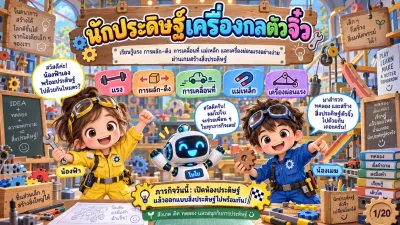
To have the whole class answer at once, a teacher with a Classroom Pass can open the "Forces and motion" question set in Classroom Mode. Pupils join with a room code, and the teacher gets an end-of-lesson summary showing which question was missed most. The Grade 5 set on force and pressure is there for when children are ready to go further. For teachers who want slides, the Little Inventors teaching media covers forces, magnets and simple machines.
Worksheets from this article
Grades 1–3 (P.1–P.3)
Force and Movement - Push or Pull
Grades 1–3 (P.1–P.3)
Magnets - Attracted or Not
Grades 1–3 (P.1–P.3)
Little Inventors - Forces, Magnets and Simple Machines (Teaching Media)
Grades 1–3 (P.1–P.3)