
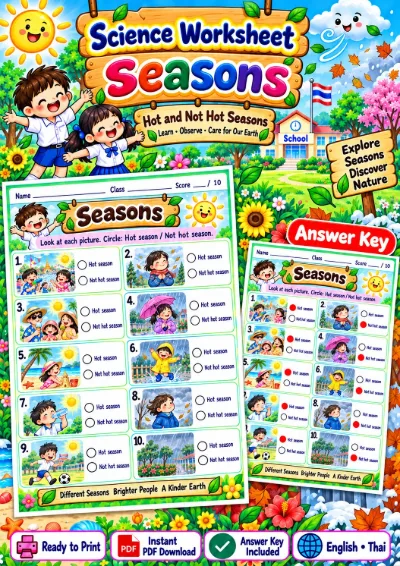
Grades 4–6 (P.4–P.6)
Seasons - Circle the Answer
19 Baht
View detailsScience
An AR classroom game for Grade 5. Learners can aim with their hands at the camera or play by tapping the screen.
This set has 4 rounds in an interactive sorting activity.
Curriculum indicatorว 1.1 ป.5/2
A look before you play
A few real prompts from the game to help you choose an activity for your class.
Sort into
An ecosystem contains both living and non-living parts, all connected.
Sort into
Decomposers turn dead matter back into nutrients in the soil.
Sort into
In some relationships both sides gain; in others one side loses out.
Before you play
Ecosystem sorting: living and non-living components, producers or consumers versus decomposers, relationships where both gain versus one loses, and water versus air pollution. Fits ว 1.1 ป.5/2 (relationships between living things) and ป.5/4 (caring for the environment).
4 questions, a sorting game with four items each - A tree and an insect are living; sunlight and water are non-living - Fungi and bacteria are decomposers; a rice plant and a rabbit are producer or consumer - Bee and flower, myna and buffalo both gain; tick and dog, mistletoe and tree, one loses - Waste water into a canal is water pollution; car exhaust and forest burning are air pollution
Use it after surveying a small ecosystem at school, such as the field or a pond, about 6 minutes in teams. After question 3, ask teams for more examples from home or the rice fields. Question 4 links to seasonal smoke haze from forest and stubble burning; ask for ways to reduce it. You can link it to a class and record it in the gradebook.
- Question 3: putting myna and buffalo with one loses, thinking the bird pecks the buffalo. Explain that the bird eats ticks off it, so the buffalo gains. - Question 2: calling fungi producers because they grow from the soil like plants. Stress that fungi have no chlorophyll and cannot make food. - Question 1: calling water living because life needs it. Separate needed for life from being alive.
Grades 4–6 (P.4–P.6)
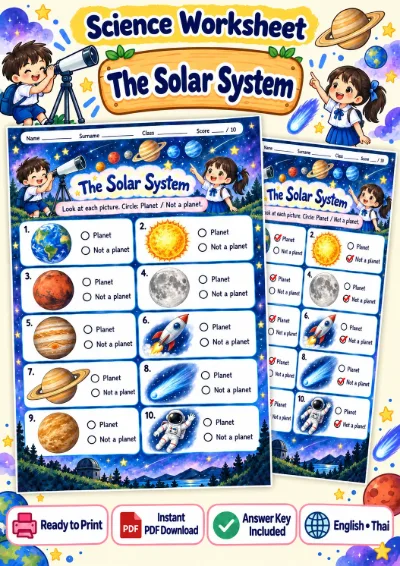
Grades 4–6 (P.4–P.6)
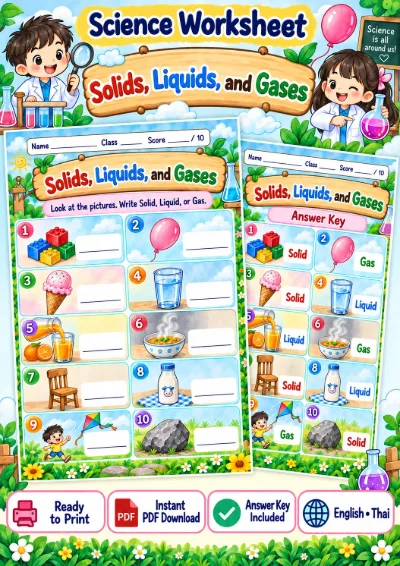
Grades 4–6 (P.4–P.6)
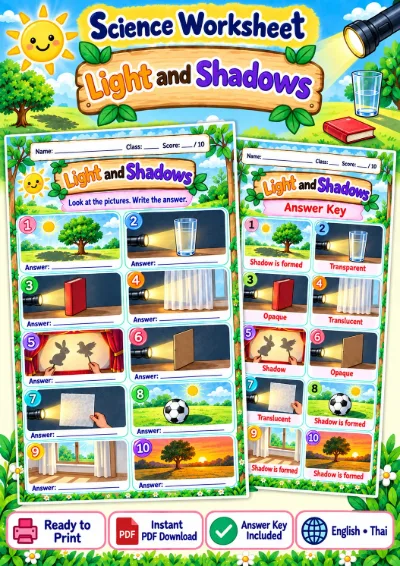
Grades 4–6 (P.4–P.6)
 Sorting
ScienceGrade 14 rounds
 Matching
ScienceGrade 14 rounds
 Multiple choice
ScienceGrade 16 questions
 Multiple choice
ScienceGrade 16 questions