
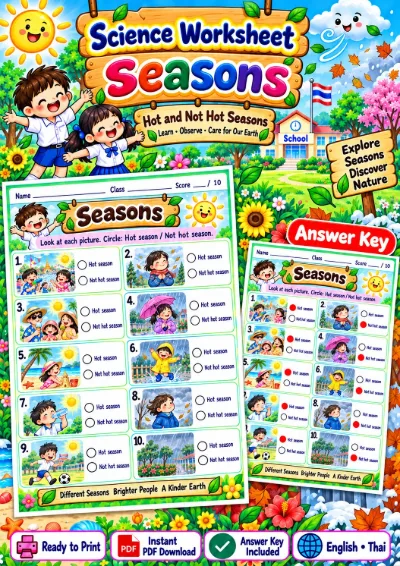
Grades 4–6 (P.4–P.6)
Seasons - Circle the Answer
19 Baht
View detailsScience
An AR classroom game for Grade 5. Learners can aim with their hands at the camera or play by tapping the screen.
This set has 4 rounds in an interactive sorting activity.
Curriculum indicatorว 2.1 ป.5/3
A look before you play
A few real prompts from the game to help you choose an activity for your class.
Sort into
A physical change can be reversed; a chemical change makes a new substance.
Sort into
Some substances dissolve in water and some do not.
Sort into
Choose the method to suit the properties of what is mixed.
Before you play
Sorts changes in matter: physical or chemical, dissolves or not, separating by filtering or evaporation, and acidic or basic substances. Fits ว 2.1 ป.5/2 (dissolving), ป.5/3 (chemical change) and ว 2.1 ป.6/1 (separating mixtures).
4 questions, a sorting game with four items each - Ice melting and tearing paper are physical; paper burning and iron rusting are chemical - Salt and sugar dissolve; sand and oil do not - Separating sand or leaves from water uses filtering; salt from brine and salt pans use evaporation - Lime juice and vinegar are acidic; soap and baking soda are basic
Use it after dissolving and separating experiments, about 6-8 minutes in teams. On question 1, be careful with the game's explanation that physical changes are reversible, since torn paper cannot be put back; use the test is a new substance formed? instead. For question 4, never let children taste substances to test them; use litmus paper or butterfly-pea flower water. You can link it to a class and record it in the gradebook.
- Question 1: calling tearing paper chemical, having learnt that physical changes must be reversible. Change the test to whether a new substance forms. - Question 2: saying oil dissolves because it mixes when shaken. Let it stand and watch it separate into layers. - Question 4: calling soap an acid, not knowing it is a base. Test it with butterfly-pea water to see the colour change.
Grades 4–6 (P.4–P.6)
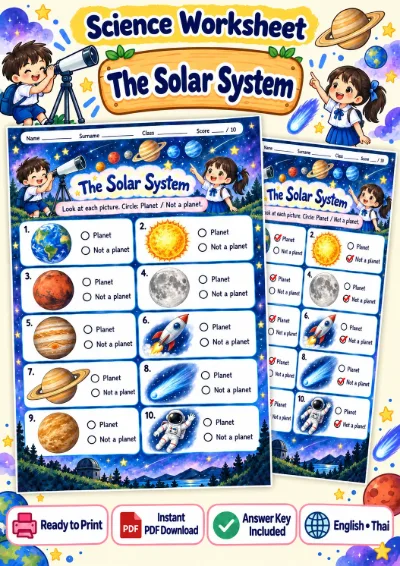
Grades 4–6 (P.4–P.6)
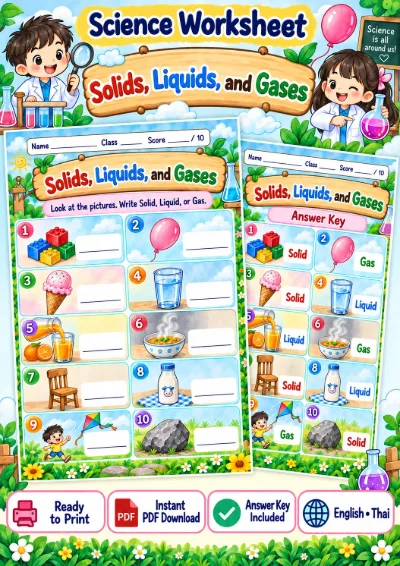
Grades 4–6 (P.4–P.6)
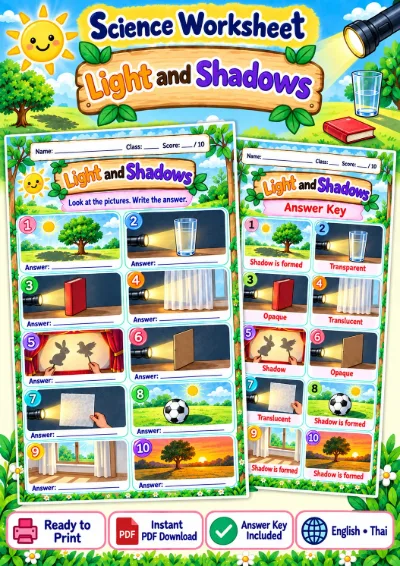
Grades 4–6 (P.4–P.6)
 Sorting
ScienceGrade 14 rounds
 Matching
ScienceGrade 14 rounds
 Multiple choice
ScienceGrade 16 questions
 Multiple choice
ScienceGrade 16 questions