
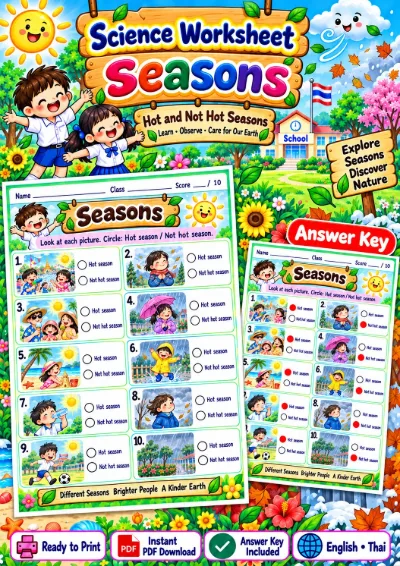
Grades 4–6 (P.4–P.6)
Seasons - Circle the Answer
19 Baht
View detailsScience
An AR classroom game for Grade 4. Learners can aim with their hands at the camera or play by tapping the screen.
This set has 6 questions in an interactive multiple choice activity.
Curriculum indicatorว 2.3 ป.6/1
A look before you play
A few real prompts from the game to help you choose an activity for your class.
It needs a power source, wires and a device - all three - before it works.
A circuit must be complete for current to flow; a break anywhere and the light goes out.
A wire's core is usually copper, because it conducts electricity well and bends easily; plastic and rubber are the insulating cover outside.
Before you play
Simple circuits: the parts of a circuit, the need for an unbroken loop, copper wire cores, insulation, what a switch does and electrical safety. It matches indicator ว 2.3 ป.6/1 (parts and functions of a simple circuit), a Grade 6 topic.
6 questions, multiple choice with three options each - A simple circuit needs a battery, wires and a bulb - If a wire breaks the bulb goes out - Wire cores are copper and covered in rubber because rubber insulates - A switch breaks or completes the circuit; never touch electrical devices with wet hands
Best after children have built real circuits with a battery, wires and a bulb, about 5-6 minutes, solo. In question 1 the distractor wires, a bulb and a switch looks complete but has no power source: let children try it without the battery. Questions 4 and 6 lead into safety talk, such as telling an adult about a damaged cable at home rather than fixing it. You can link it to a class and record it in the gradebook. Question 4 says wires are covered in rubber, but most household cable today is insulated with PVC plastic; tell children both rubber and plastic are insulators.
- Question 1: choosing wires, a bulb and a switch because every room at home has switches. Point out that without a battery there is no electricity. - Question 6: choosing it is fine to unplug by pulling the cord, a common habit. Explain that pulling can break the wires inside and is dangerous. - Question 3: choosing plastic or rubber because they only see the outside of a cable. Strip an old cable to show the copper core.
Grades 4–6 (P.4–P.6)
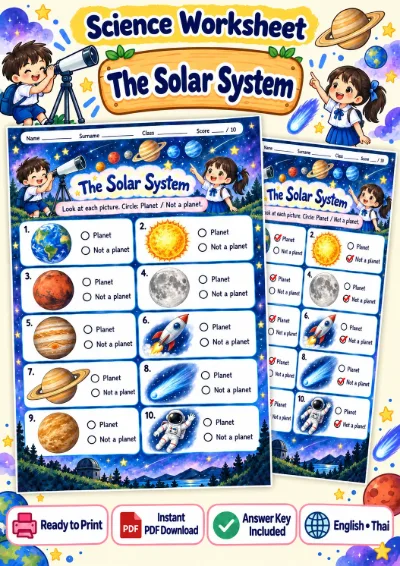
Grades 4–6 (P.4–P.6)

Grades 4–6 (P.4–P.6)
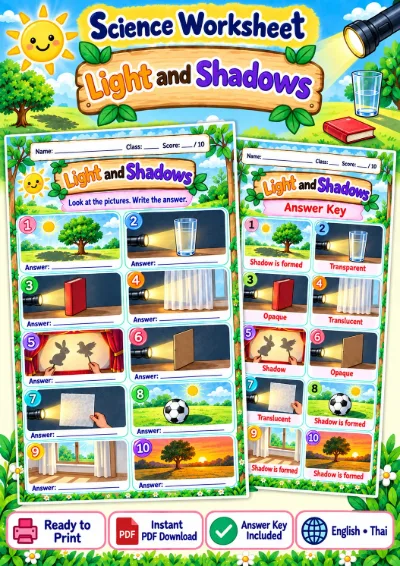
Grades 4–6 (P.4–P.6)
 Sorting
ScienceGrade 14 rounds
 Matching
ScienceGrade 14 rounds
 Multiple choice
ScienceGrade 16 questions
 Multiple choice
ScienceGrade 16 questions