
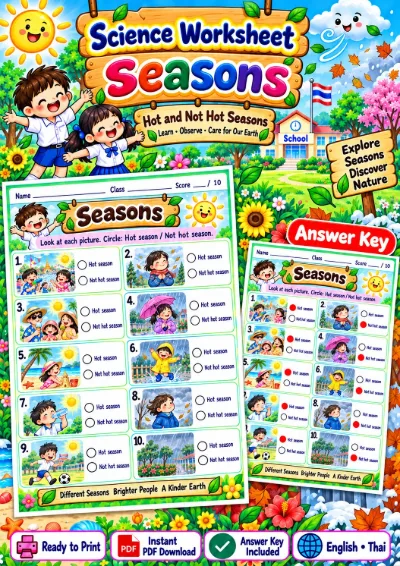
Grades 4–6 (P.4–P.6)
Seasons - Circle the Answer
19 Baht
View detailsScience
An AR classroom game for Grade 4. Learners can aim with their hands at the camera or play by tapping the screen.
This set has 6 questions in an interactive multiple choice activity.
Curriculum indicatorว 3.1 ป.4/2
A look before you play
A few real prompts from the game to help you choose an activity for your class.
The moon has no light of its own; it reflects the sun's.
The moon's position relative to the earth and the sun keeps changing.
About twenty-nine and a half days, which is where the lunar month comes from.
Before you play
The Moon and its phenomena: it reflects sunlight, its phases, how long it takes to orbit Earth, solar and lunar eclipses, and why we always see one side. Fits ว 3.1 ป.4/2 (the Moon's changing appearance); questions 4 and 5 belong to ว 3.1 ป.6/1 (eclipses).
6 questions, multiple choice with three options each - The Moon has no light of its own; it reflects sunlight - Phases come from the Moon's changing position as it orbits Earth (distractor: Earth's shadow) - One orbit takes about 1 month - A solar eclipse is the Moon blocking the Sun; a lunar eclipse is Earth blocking the light to the Moon
Use it after children have recorded the Moon's shape at home for one or two weeks, about 6 minutes in teams. For questions 2, 4 and 5, use a three-person model: one holds a torch as the Sun, one is Earth, one holds a ball as the Moon, then move them for each phenomenon. Question 3 links to the lunar calendar and Buddhist holy days (วันพระ). You can link it to a class and record it in the gradebook.
- Question 2: choosing Earth's shadow, a very common misconception. Use the three-person model to show that Earth's shadow does not fall on the Moon during its phases. - Questions 4 and 5: swapping them because สุริย and จันทร are unfamiliar. Remember: สุริยะ is the Sun being blocked, จันทร is the Moon being blocked. - Question 6: choosing the Moon does not spin at all. Have a child walk around a chair always facing it, then ask how many times they turned.
Grades 4–6 (P.4–P.6)
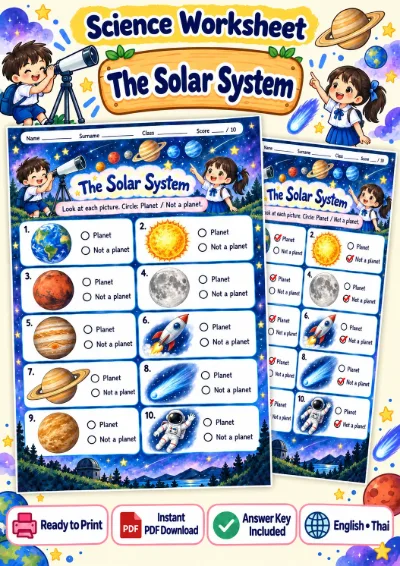
Grades 4–6 (P.4–P.6)
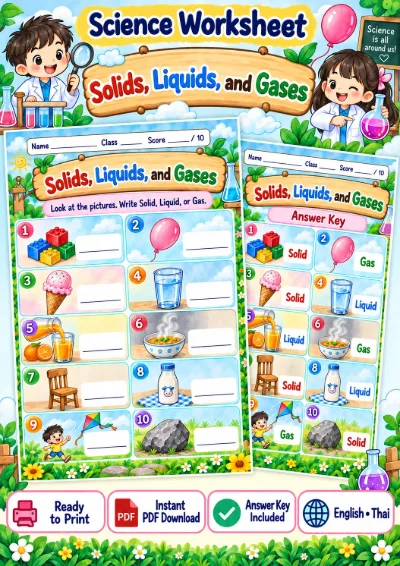
Grades 4–6 (P.4–P.6)
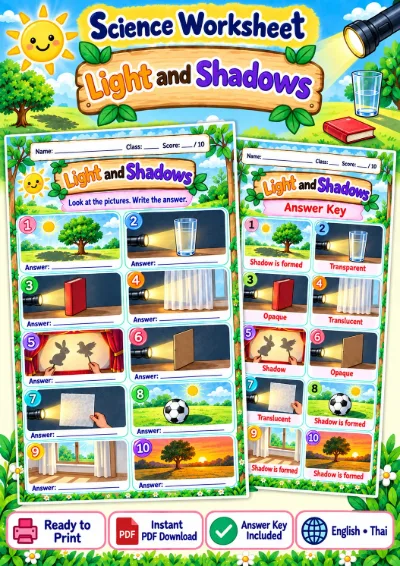
Grades 4–6 (P.4–P.6)
 Sorting
ScienceGrade 14 rounds
 Matching
ScienceGrade 14 rounds
 Multiple choice
ScienceGrade 16 questions
 Multiple choice
ScienceGrade 16 questions