
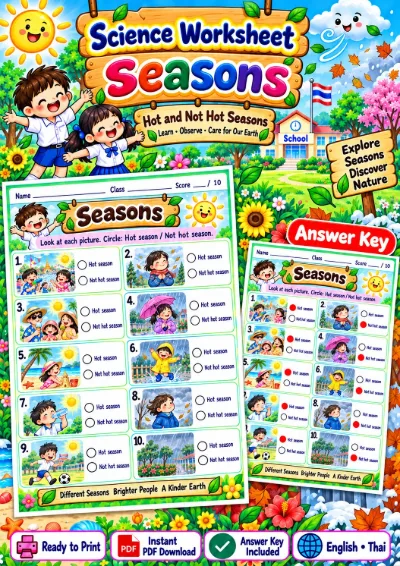
Grades 4–6 (P.4–P.6)
Seasons - Circle the Answer
19 Baht
View detailsScience
An AR classroom game for Grade 4. Learners can aim with their hands at the camera or play by tapping the screen.
This set has 4 rounds in an interactive matching activity.
Curriculum indicatorว 2.1 ป.5/1
A look before you play
A few real prompts from the game to help you choose an activity for your class.
Each change of state has its own name.
You can see changes of state around you every day.
The states differ in how their particles are arranged.
Before you play
Names the changes of state, matches everyday examples, compares the properties of the three states, and links key temperatures to events. Questions 1-2 match indicator ว 2.1 ป.5/1 (changes of state on heating or cooling), a Grade 5 topic; question 3 links to ว 2.1 ป.4/3 (comparing the three states).
4 questions, a matching game with four pairs each - Match gas to liquid with condensation, and solid to liquid with melting - Match droplets forming on a cold glass to condensation, and wet clothes drying to evaporation - Match liquid to fixed volume but changing shape - Match 37 degrees Celsius to human body temperature, and 0 degrees Celsius to water freezes
Use it after water change-of-state activities (boiling, freezing, watching a cold glass), about 6 minutes in teams. For question 2, leave a glass of ice on the teacher's desk from the start of the lesson so children see droplets form. Before question 3, say that a thick liquid is not a fourth state but a kind of liquid. For question 4, measure the room temperature with a real thermometer if you have one. You can link it to a class and record it in the gradebook. The in-game explanation for question 4 says temperature decides water's state, but the 37 and 25 degree pairs are body and room temperature, not states of water; point this out.
- Question 3: swapping liquid and a thick liquid, because both descriptions fit liquids. The item really is ambiguous, and a thick liquid is not a separate state; count a swap of these two pairs as correct. - Question 2: matching droplets on a cold glass to melting, thinking the ice is leaking through. Try a cold glass with no ice in it. - Question 1: swapping evaporation and condensation, both new words. Remember: evaporate means going up as vapour, condense means vapour coming back as drops.
Grades 4–6 (P.4–P.6)
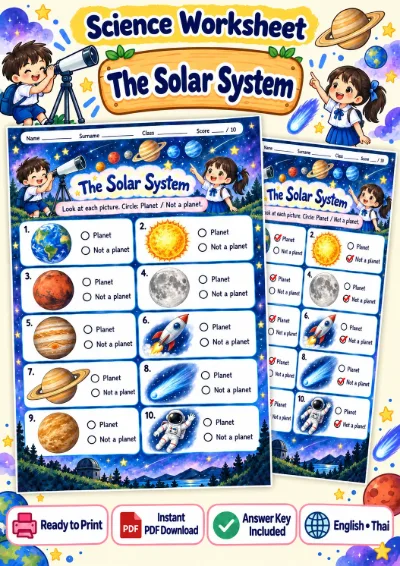
Grades 4–6 (P.4–P.6)
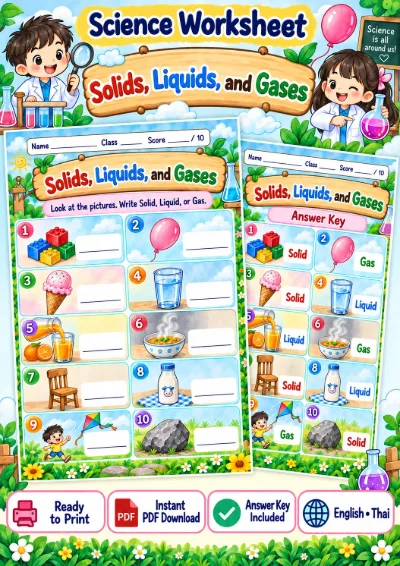
Grades 4–6 (P.4–P.6)
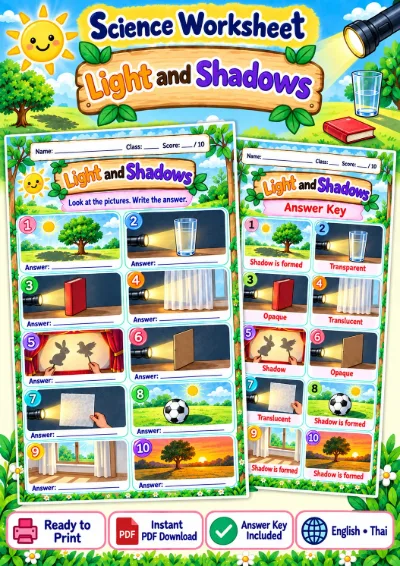
Grades 4–6 (P.4–P.6)
 Sorting
ScienceGrade 14 rounds
 Matching
ScienceGrade 14 rounds
 Multiple choice
ScienceGrade 16 questions
 Multiple choice
ScienceGrade 16 questions