
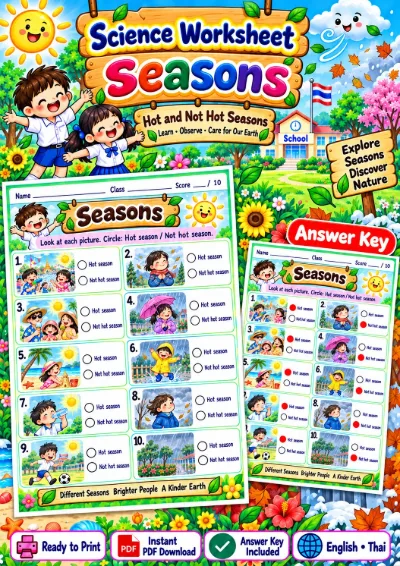
Grades 4–6 (P.4–P.6)
Seasons - Circle the Answer
19 Baht
View detailsScience
An AR classroom game for Grade 5. Learners can aim with their hands at the camera or play by tapping the screen.
This set has 4 rounds in an interactive matching activity.
Curriculum indicatorว 2.3 ป.5/1
A look before you play
A few real prompts from the game to help you choose an activity for your class.
The basic vocabulary of sound waves.
Sound travels faster through solids than through liquids or air.
Instruments make sound in different ways.
Before you play
Sound vocabulary and ideas: frequency, amplitude, pitch, loudness, the speed of sound in different media, how instruments make sound, and the parts of the ear. Matches ว 2.3 ป.5/1 (hearing through a medium) and ป.5/2-5/3 (high and low, loud and soft sounds).
4 questions, a matching game with four pairs each - Match frequency to vibrations per second and amplitude to the size of the vibration - Match iron to fastest and a vacuum to sound cannot travel at all - Match a flute to blown so the air vibrates and a ranat to struck so the bars vibrate - Match the eardrum to vibrates with the sound waves and the auditory nerve to sends the signal to the brain
Use it after sound experiments such as twanging a ruler on the desk edge or blowing across bottles, about 6 minutes in teams. For question 1, have a team demonstrate with a ruler: change the overhang for pitch, twang harder or softer for loudness. For question 3, play the school's Thai instruments if you have them. Question 4 leads into caring for your ears and avoiding loud noise. You can link it to a class and record it in the gradebook.
- Question 1: swapping pitch and loudness, since everyday Thai uses เสียงสูง loosely for loud. Separate them clearly with the ruler. - Question 1: swapping frequency and amplitude, both new technical words. Pair frequency with pitch and amplitude with loudness. - Question 2: matching water to fastest because sounds underwater seem clear.
Grades 4–6 (P.4–P.6)
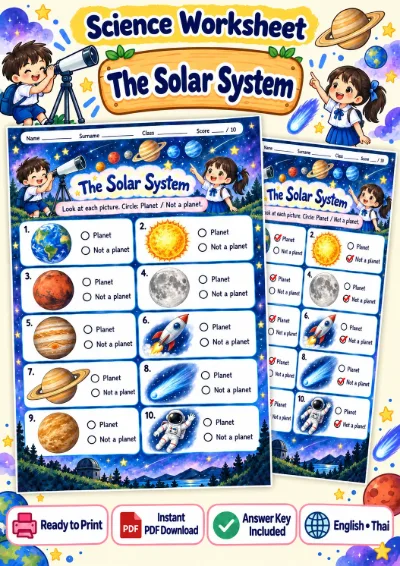
Grades 4–6 (P.4–P.6)
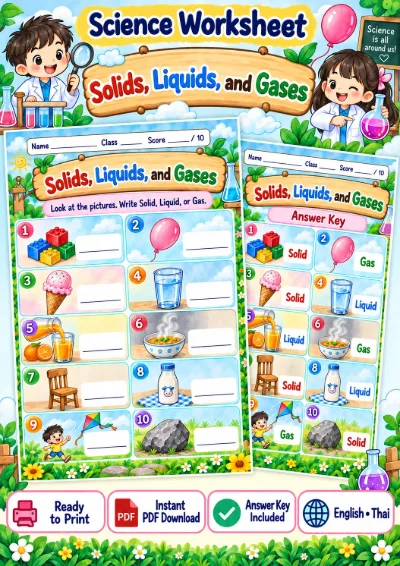
Grades 4–6 (P.4–P.6)
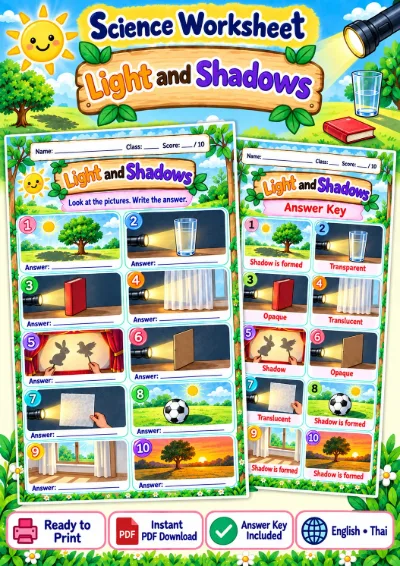
Grades 4–6 (P.4–P.6)
 Sorting
ScienceGrade 14 rounds
 Matching
ScienceGrade 14 rounds
 Multiple choice
ScienceGrade 16 questions
 Multiple choice
ScienceGrade 16 questions