
Grades 4–6 (P.4–P.6)
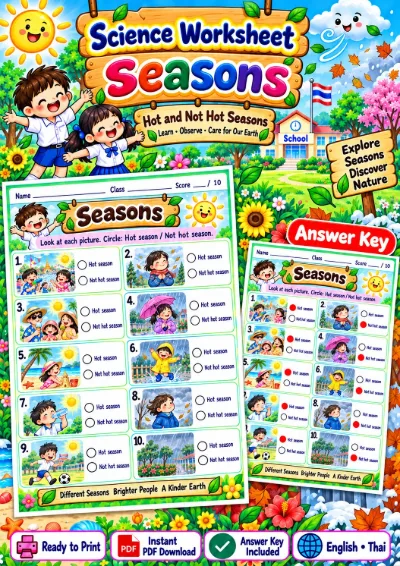
Seasons - Circle the Answer
19 Baht
View detailsScience
An AR classroom game for Grade 6. Learners can aim with their hands at the camera or play by tapping the screen.
This set has 4 rounds in an interactive matching activity.
Curriculum indicatorพ 4.1 ป.6/2
A look before you play
A few real prompts from the game to help you choose an activity for your class.
Each system has one organ that does the essential work.
Many illnesses are prevented by everyday habits.
Each addictive substance damages a different system.
Before you play
Matches body systems to their main organs, illnesses to prevention, addictive substances to the harm they do, and vaccines to the diseases they prevent. This is health-education content: questions 2 and 4 match indicator พ 4.1 ป.6/2 (the impact of outbreaks and preventing key communicable diseases in Thailand), and question 3 links to พ 5.1 ป.6/3 (why people become addicted).
4 questions, a matching game with four pairs each - Match the nervous system to the brain and spinal cord, and the immune system to white blood cells - Match diarrhoea to eat food that is cooked and clean, and tooth decay to brush and cut down on sweets - Match cigarettes to damage the lungs and alcohol to damages the liver - Match the tetanus vaccine to tetanus and the measles vaccine to measles
Use it in a health unit or before the school's anti-drug campaign, about 6 minutes in teams. Use question 3 to open a factual conversation without frightening children, and point them to where they can get help: their class teacher, or the Thai hotlines 1600 (quit smoking), 1413 (quit drinking) and 1165 (drugs). After question 4, ask children to look at their own vaccination record at home. On question 1 you can mention briefly that the reproductive system is studied in more depth later. You can link it to a class and record it in the gradebook.
- Question 3: swapping methamphetamine and solvents, since brain and nervous system overlap. Accept that both damage the brain and nervous system. - Question 1: matching the immune system to kidneys, not knowing immunity has no single organ. Explain that white blood cells are the main germ fighters. - Question 4: swapping influenza and measles because both bring fever. Point out that each vaccine's name matches its disease. - Question 1 asks for the main organ, but white blood cells are cells, not an organ. Explain that the immune system has no single organ, so the game uses white blood cells to stand for it.
Grades 4–6 (P.4–P.6)
Grades 4–6 (P.4–P.6)
Grades 4–6 (P.4–P.6)
Grades 4–6 (P.4–P.6)
 Sorting
ScienceGrade 14 rounds
 Matching
ScienceGrade 14 rounds
 Multiple choice
ScienceGrade 16 questions
 Multiple choice
ScienceGrade 16 questions