
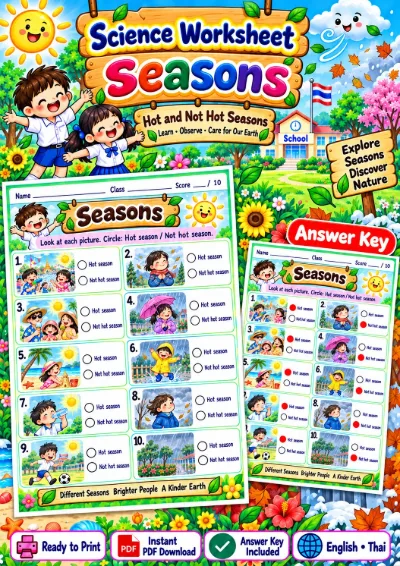
Grades 4–6 (P.4–P.6)
Seasons - Circle the Answer
19 Baht
View detailsScience
An AR classroom game for Grade 6. Learners can aim with their hands at the camera or play by tapping the screen.
This set has 6 questions in an interactive multiple choice activity.
Curriculum indicatorว 2.3 ป.6/5
A look before you play
A few real prompts from the game to help you choose an activity for your class.
A series circuit has one path: break it anywhere and the whole circuit goes out.
A series circuit has one path, so a break anywhere stops the current entirely.
A parallel circuit has several paths, so current still reaches the others.
Before you play
Compares series and parallel circuits, what happens when a bulb fails, how an electromagnet is made and strengthened, and its advantage over a permanent magnet. Questions 1-3 match indicator ว 2.3 ป.6/5 (bulbs in series and parallel), with a link to ป.6/6 (uses and limits of each); questions 4-6 on electromagnets are not in the primary indicators and work as enrichment.
6 questions, multiple choice with three options each - Series has one path, so one break turns everything off - When one bulb in a parallel circuit fails, the others stay lit - An electromagnet is made by passing current through wire coiled round an iron core - Make it stronger with more turns or more current; its advantage is that it can be switched on and off
Use it after building series and parallel circuits and winding wire round an iron nail with a battery to pick up staples, about 6 minutes, solo. For question 5, count staples lifted with ten turns versus twenty. For question 6, mention scrapyard cranes or electric bells. Warn children that wire and battery can get hot if left connected. You can link it to a class and record it in the gradebook.
- Question 3: choosing the others dim to half, thinking current must be shared. Build a parallel circuit and remove one bulb. - Question 6: choosing always stronger, having seen cranes lift cars. Point out that a small electromagnet can be weaker than a permanent magnet. - Question 4: choosing rub an iron bar on wool, confusing it with static electricity.
Grades 4–6 (P.4–P.6)
Grades 4–6 (P.4–P.6)
Grades 4–6 (P.4–P.6)
Grades 4–6 (P.4–P.6)
 Sorting
ScienceGrade 14 rounds
 Matching
ScienceGrade 14 rounds
 Multiple choice
ScienceGrade 16 questions
 Multiple choice
ScienceGrade 16 questions