

Colours belong near the front of any vocabulary plan, because children can see examples all around them all day long. Everything in the room is a teaching aid. Most of your class already knows the colours solidly in Thai, so you have only one job left: putting an English label on something they already understand.
The 11 Core Colours, in the Order Worth Teaching Them
- First set of four: red, blue, green, yellow. These come up most often and are the easiest to pronounce.
- Second set of four: black, white, pink, orange. Watch out for orange, which is both a colour and a fruit, and use that overlap to link the two topics.
- Third set of three: purple, brown, gray. Slightly harder, so save them until last.

Don't Stop at the Colour Names, Teach Them in Sentences
A child who can only say red when you point at something red isn't using the language yet. Practise these two sentences alongside the words from the very beginning: It is red. and The bag is blue. Once the frame feels familiar, they can drop any new vocabulary into it, whatever topic comes next. That's the difference between knowing words and being able to use a language.
The Activity That Works Best: A Colour Hunt Around the Room
You say Find something blue! and the children run to touch something that colour. It takes five minutes, needs no preparation at all, and covers listening while tying every word to a real object. Follow it with a worksheet matching colours to words so the learning lands on paper. Finish with a colouring task driven by an English instruction, something like Colour the ball red. That tells you far more about real understanding than asking out loud does.
A Lesson Plan That Fits in 12 Minutes
Minutes 0 to 2: hold up four real objects in four different colours, one at a time. Name the colour, point at it, and have the class repeat it once. Don't start with word cards. At this stage children need to attach the sound to an object they can see.
Minutes 3 to 6: put all four objects together and mix your instructions between Show me red. and Touch something blue. Let them answer by pointing or touching first, and only then ask for the colour name. This shows you straight away who understands what they hear and who is only echoing you.
Minutes 7 to 10: move from single words to the sentence It is red. Point at one object, leave a short pause, then have the class say it back. After that, let the children take turns choosing an object and saying the sentence themselves.
Minutes 11 to 12: run a simple exit check where each child points at one object and produces one sentence. If a child can't manage it, note whether they're stuck on hearing the colour, on pronouncing it, or on the sentence frame, then reteach just that piece next lesson.
- Don't put colours that sound alike in the same first lesson. Green and gray together will get mixed up.
- When a child answers in Thai, accept the answer first, then give the English word and have them repeat it. There's no need to correct sharply.
- In a cramped classroom, swap Find something... for Point to something... and you get the same result.
Worksheets from this article
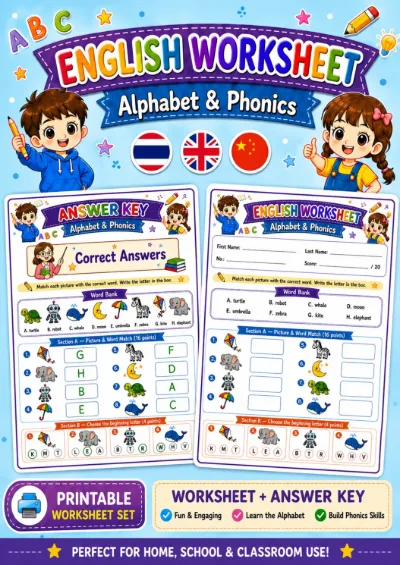
Grades 1–3 (P.1–P.3)
Colours - Match the Colours and Words
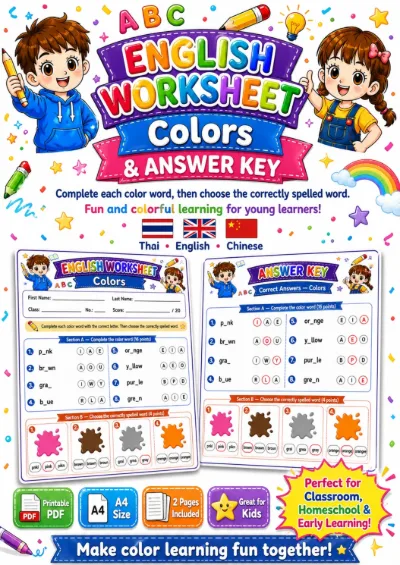
Grades 1–3 (P.1–P.3)
Colours - Spell the Colour Words
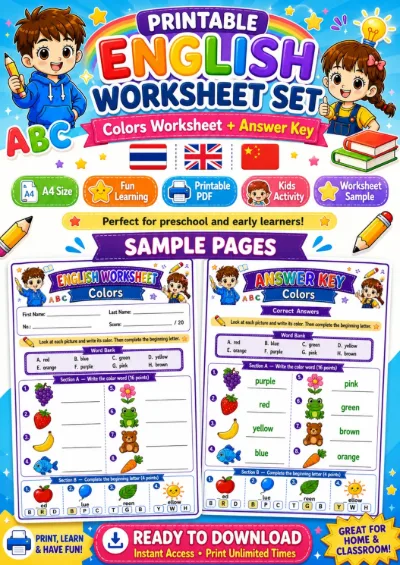
Grades 1–3 (P.1–P.3)