

5 December is National Father's Day in Thailand. It is the birthday anniversary of His Majesty King Bhumibol Adulyadej the Great, and a public holiday, so schools usually hold Father's Day activities on the school days before it, such as making cards or writing messages to fathers.
It is a good moment for English lessons, because children have a real reason to write and a real reader waiting at home. This article is a three-lesson plan: family vocabulary in lesson one, sentences describing dad in lesson two, and writing a card in lesson three. It works for Grades 1 to 3 and Grades 4 to 6 by adjusting the length of the writing.
Before you start: every child's family is different
Every class has children who do not live with their father. Some live with grandparents, some with their mother alone, and some have fathers working in another province. Before you begin, tell the whole class that the card can go to dad or to whoever looks after them like a dad, such as a grandfather or an uncle, and teach words for these people from lesson one. Children can then choose without having to explain themselves to classmates, and a teacher should not ask why in front of the class.
Lesson 1: family words, from father to dad
Start with words most children know, father, mother, brother and sister, then add grandfather, grandmother, baby and family. What is worth adding in this lesson is the everyday forms dad, mum, grandpa and grandma, because real cards say Dear Dad far more often than Dear Father. Show children that father and dad mean the same person, but dad is the friendly word you use when talking or writing to your own father.
The family vocabulary matching worksheet has an 8-word bank, grandmother, father, sister, baby, grandfather, mother, brother and family, and works as the first task of the lesson in about 10 to 15 minutes. Its teacher's guide warns that children often swap father and brother, and mother and sister, because the pictures differ only by age, so point to the pictures and ask who is older before they start. The missing-letters spelling worksheet works as homework.
From Grade 3 up, or in classes where some children will write to an uncle, add uncle, aunt, cousin and grandparents. The family write-the-words worksheet has these in its word bank. Thai children are often amazed that one English word, uncle, covers ลุง, น้า and อา, which Thai keeps apart by side of the family and age.
Lesson 2: sentences about dad
A good card says more than I love you. Children need sentences about what their dad is like and what they do together. Put sentence frames on the board and practise them aloud before writing.
- This is my dad. His name is ...
- My dad is kind. / funny. / strong. / brave.
- He can cook. / He can fix my bike.
- I like to play football with my dad.
The usual sticking point for Thai children here is his and her, because Thai uses the same word for both. If a child writes about dad and uses her, point back to dad and ask whether dad is a man or a woman. The possessive adjectives worksheet, where children circle my, his, her or their, gives about 10 minutes of practice. A speaking activity before writing also helps: in pairs, one child says three sentences about their dad or carer, and the partner retells them to the teacher starting with His dad is ..., which forces the switch from my to his straight away.
Lesson 3: writing a Happy Father's Day card
An English card has a fixed shape. Write it on the board and let children fill it in.
- Dear Dad,
- Happy Father's Day!
- You are kind. Thank you for ... (for example Thank you for cooking for me. or Thank you for taking me to school.)
- I love you very much.
- Love,
- (child's name)
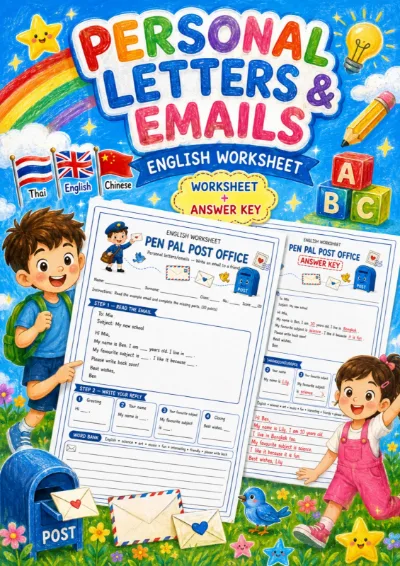
Adjust the length by level. Grade 1 children copy the frame and add their name and one describing word, such as kind. Grade 2 and 3 children fill two or three gaps and choose a Thank you for ... sentence from options you prepare. Grade 4 to 6 children write four or five sentences of their own, with an opening and a closing, and describe one thing they did together. The Grade 4 to 6 personal letters and emails worksheet, where children read a model email before writing a reply, helps set up the opening, body and closing.
If the school makes cards together with the art lesson, children might draw a yellow canna flower (ดอกพุทธรักษาสีเหลือง), the symbol of Thai Father's Day, on the card and write for you under it.
Common mistakes on the cards
The same mistakes turn up every year, so put them on the board as a checklist before children hand in.
- Fathers Day or Father Day: the correct form is Father's Day, with an apostrophe s.
- dear dad: Dad used as a name for your own father takes a capital letter, and there is a comma after Dear Dad, and after Love,
- I very love you or I love very much you: this follows Thai word order. The correct sentence is I love you very much.
- My dad he is kind: a doubled subject. The correct sentence is My dad is kind.
- farther instead of father: a spelling slip because they sound alike.
- Thank you for cook for me: the verb after for takes -ing. In Grades 1 to 3, let children pick ready-made sentences instead of explaining the rule.
Linking to the calendar and to culture
For Grades 4 to 6, this lesson links to days and months. Have children write In Thailand, Father's Day is on 5 December, then explain that in many countries, such as the United States and the United Kingdom, Father's Day falls on the third Sunday in June. Children see that the same kind of day has different origins in different countries, and practise on with dates at the same time.
For parents
When your child brings the card home, ask them to read it aloud one sentence at a time and tell you what each sentence means. Do not correct the grammar that day. What your child will remember is that English can really be used to tell people at home how they feel. If you want to take it further, answer the card with a short note, such as Thank you. I love you too. It may be the first English your child reads that was written to them.
Worksheets from this article
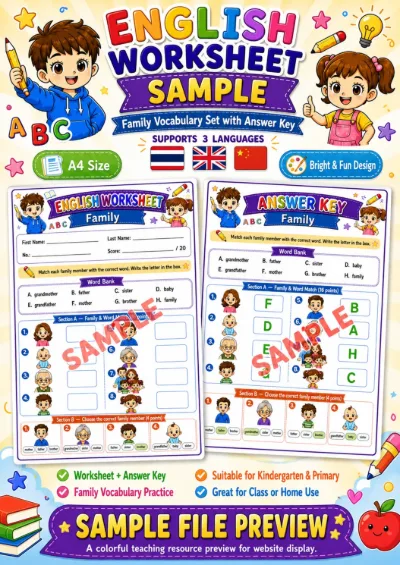
Grades 1–3 (P.1–P.3)
Family - Match the Family Members and Words
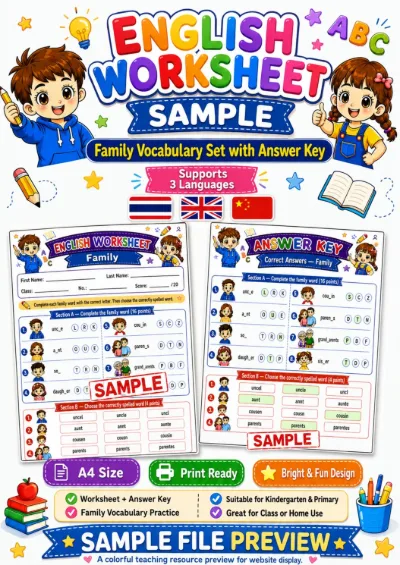
Grades 1–3 (P.1–P.3)
Family - Spell the Family Words
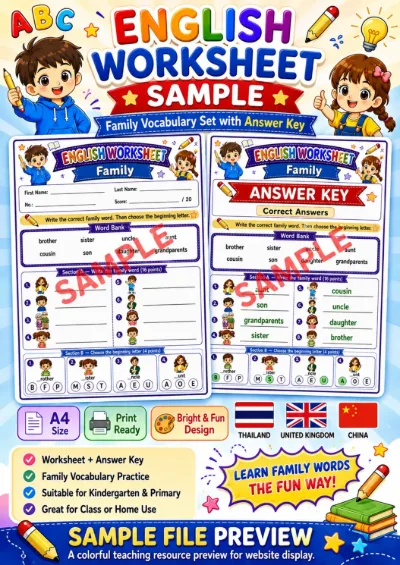
Grades 1–3 (P.1–P.3)
Family - Write the Family Words
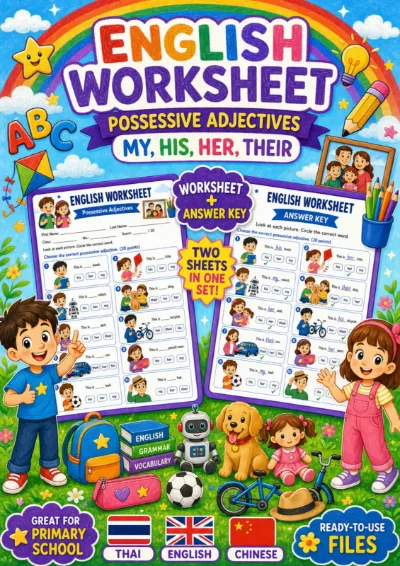
Grades 1–3 (P.1–P.3)
Possessive Adjectives - Circle the Correct Word
Grades 1–3 (P.1–P.3)
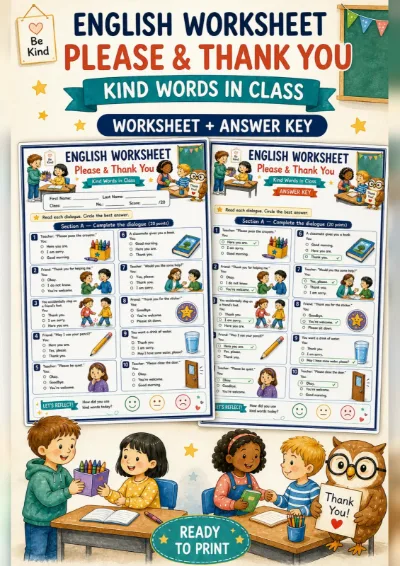
Please & Thank You - Read the Dialogue and Circle the Polite Reply
Grades 4–6 (P.4–P.6)