

Ask what they had for lunch, then teach those words in English. It beats any flashcard as a way to open this topic, because food is where children genuinely have feelings. They have favourites. They have things they can't stand. Those feelings are the glue that makes the vocabulary stick.
The word list, group by group
- Main dishes: rice, noodles, egg, chicken, fish, bread, soup.
- Drinks: water, milk, juice, tea.
- Sweets and snacks: cake, ice cream, candy, cookie.
- A bridge to the fruit topic: apple, banana, mango, watermelon. Thailand has the advantage here, because the fruit is everywhere and children already know every one of them by sight and by taste.

The sentence frames at the heart of the topic: like and don't like
Food is where children should meet the negative sentence for the first time, because here it means something to them: I like mango. I do not like fish. Vote on each food with a show of hands, then practise saying it both ways. A child who gets to announce what they don't like discovers that English can carry their own truth, not just repeat somebody else's.
The restaurant game: three lines take you a long way
Turn a couple of desks into a pretend restaurant and let children take turns as the seller and the customer. The whole script is three exchanges: What do you want? I want rice, please. Here you are. Thank you. Use food picture cards as the menu. The words get used in a real situation, and please and thank you come along for free. Close the topic with a worksheet matching foods to words, plus a drawing of their favourite plate with every food on it labelled.
Worksheets from this article
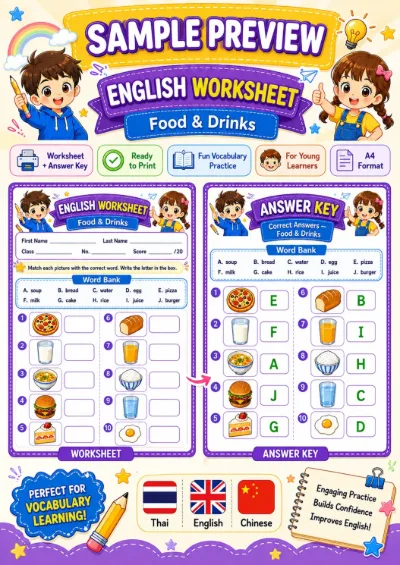
Grades 1–3 (P.1–P.3)
Food & Drinks - Match the Pictures and Words
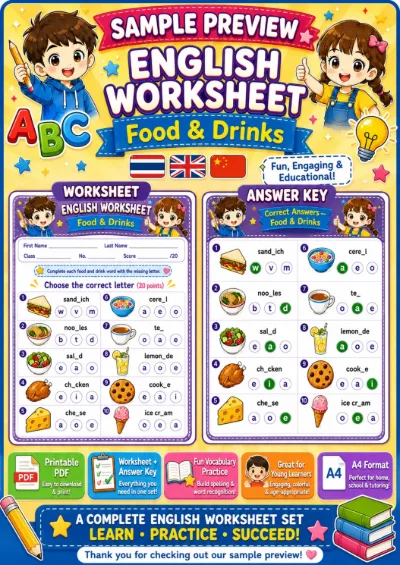
Grades 1–3 (P.1–P.3)
Food & Drinks - Fill in the Missing Letters
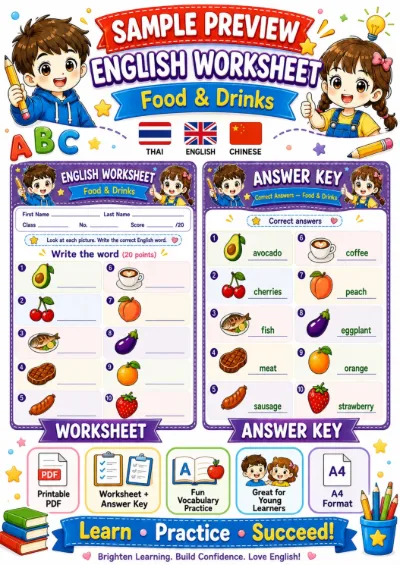
Grades 1–3 (P.1–P.3)