

Every maths teacher has seen it. A child reads half the problem, spots two numbers and the word "more", and adds. Keyword hunting seems to work in Grades 1 and 2 because problems are short and one-step, but it falls apart once problems get longer and have two steps, from Grade 3 onwards.
Try this one: "Daeng has 25 marbles. Daeng has 8 more than Dam. How many marbles does Dam have?" A child who grabs the word "more" answers 33. But if Daeng has more, Dam must have fewer: 25 - 8 = 17. The child did not make an arithmetic error; they misread the story. So this article starts with reading, then uses drawing as the bridge from the story to the number sentence.
Four steps that work for any problem
Thai primary maths textbooks use a four-step problem-solving process: understand the problem, make a plan, carry out the plan, and check. It sounds formal, but in children's words it is read it, draw it, work it out, check it.
The Grade 4 AR set on ordering problem-solving steps asks children to put "read the problem", "find what it asks", "choose the operation" and "check the answer" in order. It makes a short lesson opener to fix the process in mind before the real work starts.
Reading: three reads, each looking for something different
- First read, for the story: cover the numbers and ask who the problem is about and what they are doing. A child who can retell it in their own words has understood it.
- Second read, for the question: underline the question sentence and write the answer's unit in advance, such as "... baht". The child will not answer with a number of items when the question asks for money.
- Third read, for the data: circle every number with its unit and ask which ones are needed and which are not. Some good problems include extra information on purpose.
- For children who do not yet read fluently, have the teacher or a classmate read the problem aloud. The goal of the lesson is mathematical thinking, not a reading test.
Drawing: three kinds of bar model
A bar model uses rectangles to stand for quantities; longer means more. It does not need to be neat or to scale, as long as the larger quantity has the longer bar. Most primary problems use one of three shapes.
- Part-whole: one long bar split into parts, for combining, separating, or spending money and finding what is left.
- Comparison: two bars side by side, with the longer one sticking out by the difference, for problems about "more than" or "fewer than".
- Equal parts: one bar split into equal sections, for multiplication, division, fractions and percentages.
- Use a comparison model for the marble problem above. Daeng's bar is 25 long and Dam's is 8 shorter. Children can see at once that Dam's amount is 25 minus the part that sticks out, not 25 plus 8.
Example 1: Spending and what is left (Grades 3 to 4)
Problem: Mum gives Nam 200 baht. Nam buys 3 exercise books at 35 baht each and a box of coloured pencils for 48 baht. How much money does Nam have left?
Draw: one long bar for the 200 baht, split into three parts. The first part is the books, split again into 3 boxes of 35. The second part is the pencils, 48. The last part is the money left, marked with a question mark.
- Step 1: books cost 3 × 35 = 105 baht.
- Step 2: total spent is 105 + 48 = 153 baht.
- Step 3: money left is 200 - 153 = 47 baht.
- Check: 47 + 153 = 200, and the money left is less than the money Nam started with, so it makes sense. Answer: Nam has 47 baht left.
- Children who get this wrong usually stop at step 2 and answer 153. The drawing helps here because the question mark sits on the last part, not on the cost of the shopping.
Example 2: Compare, then combine (Grade 4)
Problem: Class 4/1 collected 186 plastic bottles. Class 4/2 collected 47 fewer than Class 4/1. How many bottles did the two classes collect altogether?
Draw: a bar of 186 for Class 4/1 and a shorter bar underneath for Class 4/2, with the gap labelled 47. Put a brace around both bars and a question mark for the total.
- Step 1: Class 4/2 collected 186 - 47 = 139 bottles.
- Step 2: both classes together collected 186 + 139 = 325 bottles.
- Check: 139 + 47 = 186. Answer: the two classes collected 325 bottles altogether.
- This problem has two traps. A child who grabs "fewer" subtracts and answers 139 straight away. A child who does not read who has fewer adds 186 + 47 = 233. The drawing shows there are two bars and the question asks for both together.
Example 3: Measurement that needs a unit change first (Grades 4 to 5)
Problem: A rope is 3 metres 60 centimetres long. It is cut into 4 equal pieces. How long is each piece in centimetres?
Before drawing, put everything in one unit. 1 metre is 100 centimetres, so the rope is 300 + 60 = 360 centimetres. Draw one bar split into 4 equal parts: 360 ÷ 4 = 90. Answer: each piece is 90 centimetres. Check: 90 × 4 = 360.
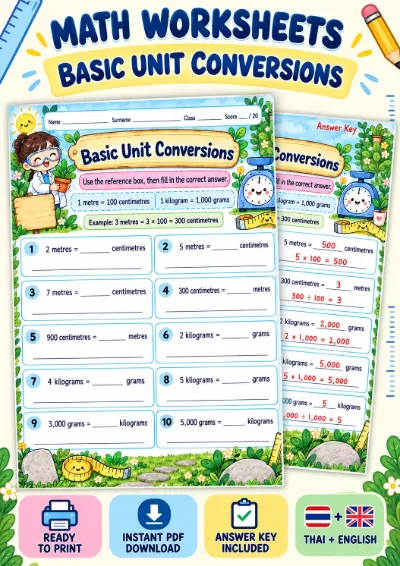
A common mistake is to work out 60 ÷ 4 = 15 and answer 15 centimetres, forgetting the metres entirely. Another is to convert to 3.6 metres, get 0.9 and write 0.9 centimetres, forgetting the unit is still metres. If unit conversion is not yet secure, the metric conversions worksheet practises that skill on its own first.
Example 4: Fractions and percentages (Grades 5 to 6)
Problem: A shop sold 240 bottles of juice. 3/8 of them were orange juice and the rest were guava. How many bottles of guava juice were sold?
Draw a bar for 240 bottles split into 8 equal parts. Shade 3 parts for orange; the other 5 are guava. One part is 240 ÷ 8 = 30 bottles, so guava is 5 × 30 = 150 bottles. Check: orange is 3 × 30 = 90, and 90 + 150 = 240.
Percentages use the same picture. A question from the Grade 5 AR set on percentage problems asks: an item costs 400 baht with 25% off, what is the new price? Draw a 400 baht bar split into 4 parts, because 25% is one quarter. Each part is 100 baht; take one away and 3 parts are left, which is 300 baht. A child who answers 375 has subtracted 25 directly, which the drawing does not allow.
Mistakes to head off early
- Keyword hunting: there is no need to forbid noticing words, but always follow up with "who has more?" and draw before choosing the operation.
- Stopping halfway: in two-step problems children often give the result of the first step. Put the question mark in the drawing before calculating, then check the answer is for that part.
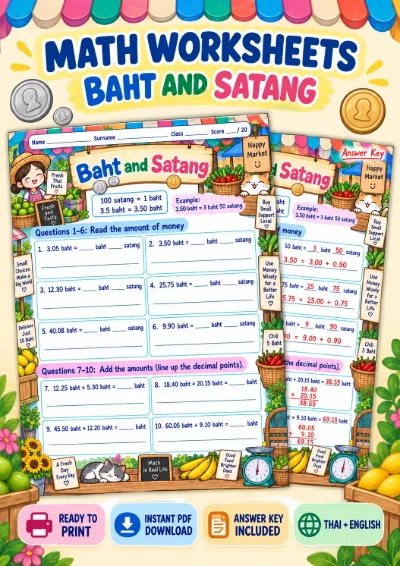
- Mismatched units: metres and centimetres, baht and satang. Convert to one unit before calculating.
- Remainders: 50 pupils travel in vans that hold 12 each. 50 ÷ 12 = 4 remainder 2, but 5 vans are needed because the last 2 pupils have to go too. The answer depends on the story, not only on the numbers.
- Answers without units or full sentences: ask for a full sentence using the problem's own words, and children will notice for themselves whether they answered the question.
Classroom routines that build real problem solvers
Problem solving improves with little and often, not long sessions just before a test. Try these routines.
- One problem a day in the first five minutes of the lesson. Draw the model only, no calculation, then compare two classmates' drawings that differ.
- Reverse it: the teacher draws a bar model and children write a story problem that fits it. A child who can write the problem understands its structure.
- Use children's own lives: snack prices at the school gate, bus fares, numbers of athletes on sports day. Children can tell for themselves whether an answer is reasonable.
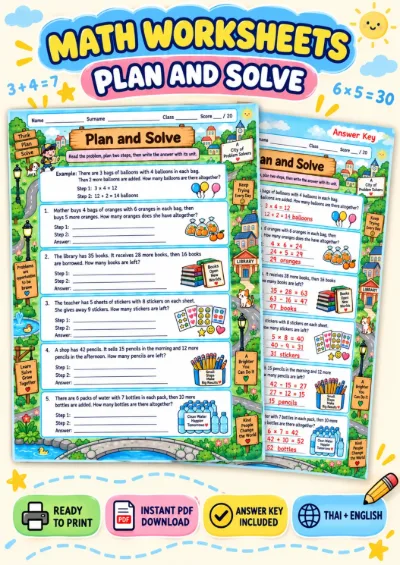
- The multi-step word problems worksheet, Plan and Solve, has separate spaces for step 1, step 2 and the answer with its unit. It suits Grade 3 or works as a warm-up for older classes. For whole-class review, the Grade 3 AR set on two-step multiplication and division problems and the Grade 4 set on multi-step problems work well once children can draw models.
Worksheets from this article
Grades 1–3 (P.1–P.3)
Multi-step Word Problems - Plan and Solve
Grades 1–3 (P.1–P.3)
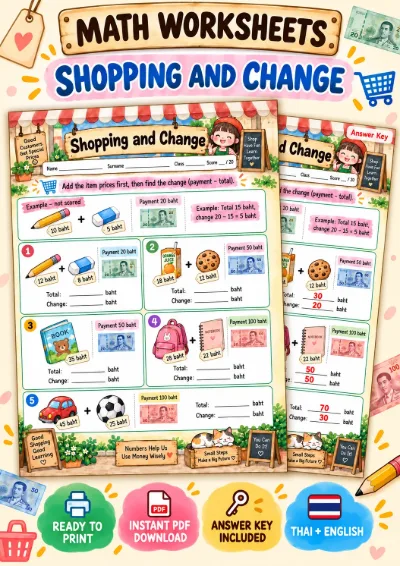
Shopping and Change - Find the Change
Grades 1–3 (P.1–P.3)
Metric Unit Conversions - Convert the Units
Grades 1–3 (P.1–P.3)