

Grades 1–3 (P.1–P.3)
Word Detective Part 2 - Final Consonants Kong, Kon, Kom, Koei, Keo (Teaching Media)
29 Baht
View details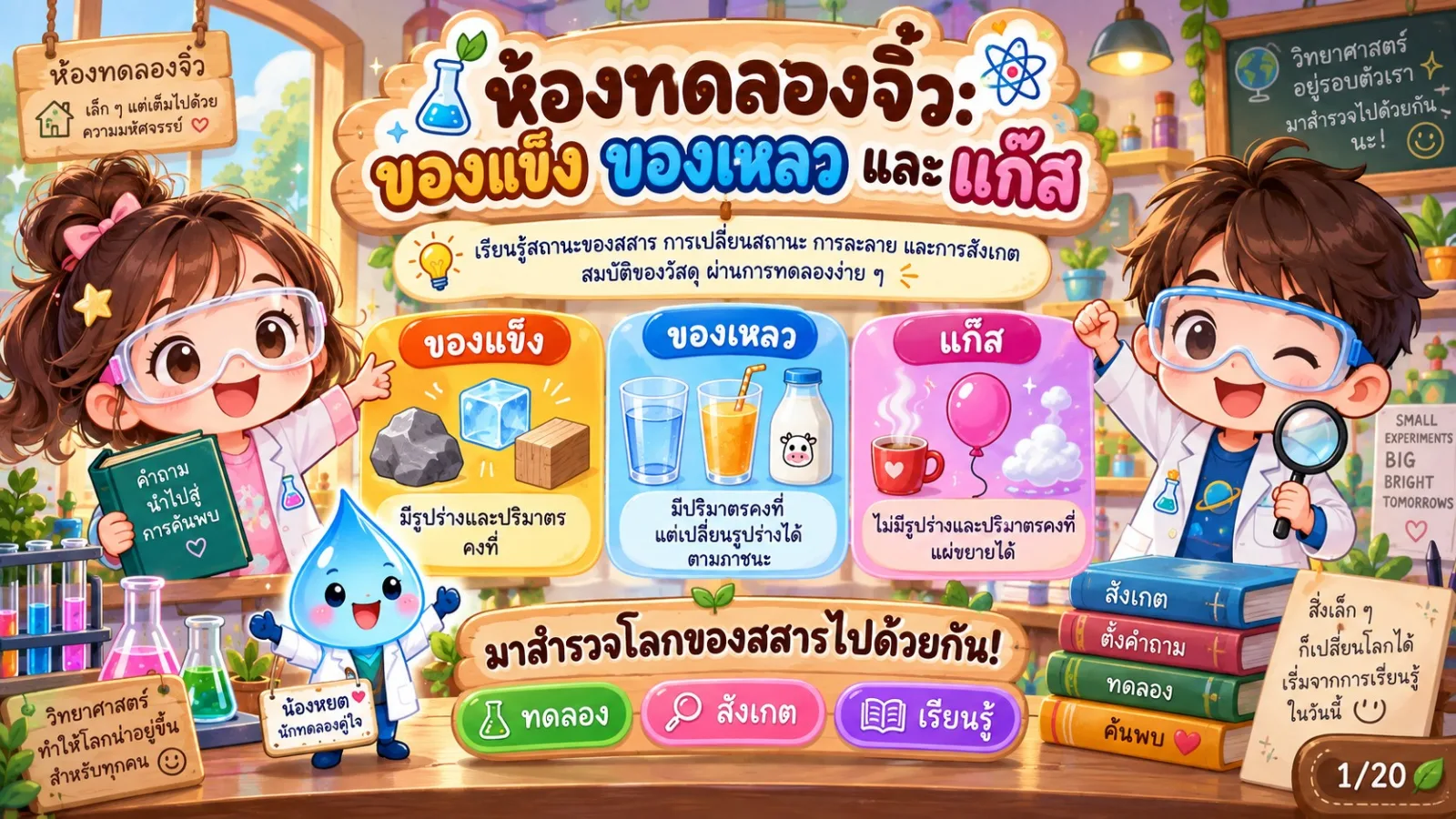
1 / 6
The preview is watermarked and lower resolution than the file you receive.
The preview is watermarked and lower resolution than the file you receive.
Science Teaching Media worksheets on Solids, Liquids and Gases for Grades 1–3 (P.1–P.3), difficulty 1/5. PDF, downloadable as soon as payment clears.
Curriculum indicators practised
Before you begin
Learn that matter has mass and takes up space, sort solids, liquids and gases by shape and volume, explain four changes of state (melting, freezing, evaporation, condensation) and the water cycle, decide what dissolves in water, and observe the properties of materials.
20 slides in a mini lab with a water-drop mascot and two young scientists - Slides 1-10, states of matter: matter has mass and volume; solids (rock, ice, spoon, building bricks), liquids (water, milk, soup, oil) and gases (air, balloon, bubbles); a table comparing shape, volume and behaviour; properties of solids (hard-soft, rough-smooth, heavy-light); properties of liquids (pour water, juice, milk and syrup to see which flows fastest); properties of gases (perfume spreading, wind turning a pinwheel); a nine-item sorting game - Slides 11-15, changes of state: melting (ice in sun and shade), freezing (an ice-cube tray), evaporation (dishes of water in sun and shade), condensation (drops on a cold glass, a pan lid, dew) and a four-step water cycle - Slides 16-18, dissolving and materials: sugar and salt dissolve, sand does not; sort sugar, salt, juice powder and syrup from sand, pepper, oil and plastic beads; observe seven materials by touching, looking and dropping water on them - Slides 19-20: a four-question review and a certificate - There are no answer slides
Use in a Year 2-3 matter unit over three lessons of about 40 minutes (slides 1-10, 11-15, 16-20); each section has a short experiment you can actually run. - Set up the experiments before slides 11 and 13, putting ice and dishes of water in sun and shade at the start of the lesson and checking at the end, and make a cold glass of ice water to show condensation for slide 14 - Afterwards set the solids, liquids and gases worksheet and the changing materials worksheet
- Thinking the white mist above hot water is gaseous water vapour; real water vapour is invisible and the mist is tiny droplets that have already condensed (slide 14 says vapour is invisible) - Thinking air and other gases are not matter because you cannot see or hold them (slide 2 uses the air in a football as an example) - Thinking dissolved sugar has disappeared, although it is still in the water and tastes sweet (slide 16) - Thinking the drops on the outside of a cold glass have leaked through from inside
A PDF written to the Thai curriculum. Buy this worksheet once and keep it; no monthly plan is required.
Download it as soon as payment clears. The link stays in your account, so you can fetch the file again whenever you need it.
Every worksheet is checked before it is published — the content, the artwork, the layout and the accuracy of the language. Download it and hand it out the same day. If printing it yourself is inconvenient, add printing and postage to the order.
By a teacher who works in Thai classrooms, for Grades 1 to 6.
Choose plain A4, heavier stock or photo paper, and we deliver it.
Grades 1–3 (P.1–P.3)

Grades 1–3 (P.1–P.3)

Grades 1–3 (P.1–P.3)

Grades 1–3 (P.1–P.3)