
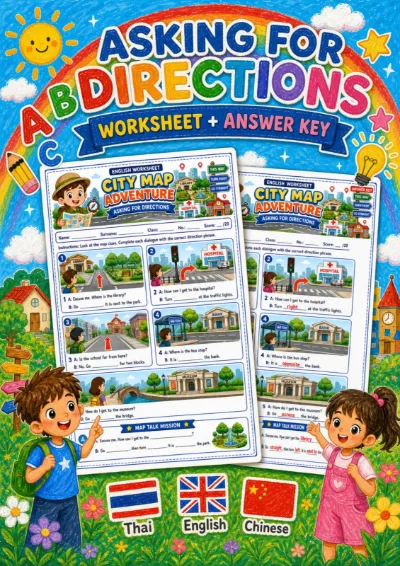
Grades 4–6 (P.4–P.6)
Asking for directions worksheet
19 Baht
View detailsEnglish
An AR classroom game for Grade 5. Learners can aim with their hands at the camera or play by tapping the screen.
This set has 6 questions in an interactive multiple choice activity.
Curriculum indicatorต 1.2 ป.5/1
A look before you play
A few real prompts from the game to help you choose an activity for your class.
"Small" plus "er" is "smaller", for comparing two things.
"Heavy" ends in y, so the y becomes i before "er".
"Big" has one vowel and one final consonant, so the g doubles before "er".
Before you play
Practise comparatives for two things: adding -er, changing y to i, doubling the last consonant, more with long words, and the irregular good to better, so pupils can compare things around them (ต 1.2 ป.5/1).
6 multiple-choice comparative gap fills - A cat is ___ than an elephant. (smaller) - This box is ___ than that one. (heavier) - My bag is ___ than yours. options more big / biger / bigger - This film is ___ than that one. (more interesting) - Today is ___ than yesterday. options best / gooder / better
Use after teaching the -er spelling rules, 5 minutes in solo mode, then have pupils compare two objects in the room. - Put the four rules on the board and ask which rule each question uses - If bigger goes wrong for many, write big, hot and thin and let pupils add -er on the board Play it linked to a class and the results go into the mark book.
- My bag is ___: choosing biger because they forget to double the g; show the one-vowel, one-final-consonant pattern - Today is ___: picking best because it is familiar, without noticing than; than always calls for the comparative - heavier: some may hesitate over the spelling; point out the y turning into i
Grades 4–6 (P.4–P.6)
Grades 4–6 (P.4–P.6)
Grades 4–6 (P.4–P.6)
Grades 4–6 (P.4–P.6)
 Matching
EnglishGrade 14 rounds
 Multiple choice
EnglishGrade 16 questions
 Sorting
EnglishGrade 14 rounds
 Ordering
EnglishGrade 14 rounds