
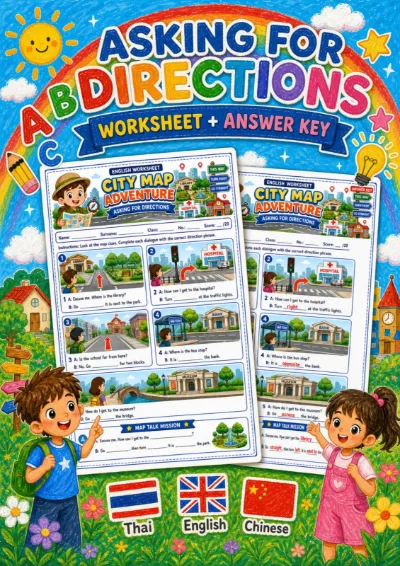
Grades 4–6 (P.4–P.6)
Asking for directions worksheet
19 Baht
View detailsEnglish
An AR classroom game for Grade 6. Learners can aim with their hands at the camera or play by tapping the screen.
This set has 4 rounds in an interactive sorting activity.
Curriculum indicatorต 1.2 ป.6/2
A look before you play
A few real prompts from the game to help you choose an activity for your class.
Sort into
In the active the subject acts; in the passive it is acted on.
Sort into
The time word signals which tense the sentence needs.
Sort into
A comparative adds "er" or takes "more", depending on the word's length.
Before you play
Practise sorting P6 structures: active versus passive sentences, time words for the past versus the present perfect, adjectives that add -er versus take more, and proper versus common nouns.
4 sorting questions - Fah wrote the letter. versus The letter was written. - yesterday and two days ago go with the past; already and never with the present perfect - tall and fast add -er; beautiful and interesting take more - Bangkok and Monday are proper nouns; city and day are common nouns
Use as a mid-term review game, 5-6 minutes in team mode, then have a team explain the passive item. - For item 1, ask who wrote the letter; if the sentence doesn't say who did it, it is probably passive - For item 4, have pupils look at the capital letters Play it linked to a class and the results go into the mark book.
- Item 2: putting never with the past because I never went is familiar; give I have never been to Japan. - Item 1: calling The letter was written. active because was is a past verb; a letter cannot do anything by itself - Item 3: hesitating over fast, which they also know as an adverb
Grades 4–6 (P.4–P.6)
Grades 4–6 (P.4–P.6)

Grades 4–6 (P.4–P.6)

Grades 4–6 (P.4–P.6)
 Matching
EnglishGrade 14 rounds
 Multiple choice
EnglishGrade 16 questions
 Sorting
EnglishGrade 14 rounds
 Ordering
EnglishGrade 14 rounds