
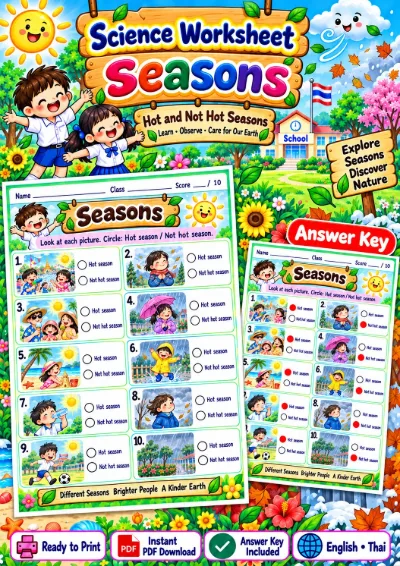
Grades 4–6 (P.4–P.6)
Seasons - Circle the Answer
19 Baht
View detailsScience
An AR classroom game for Grade 6. Learners can aim with their hands at the camera or play by tapping the screen.
This set has 6 questions in an interactive multiple choice activity.
Curriculum indicatorว 2.3 ป.3/1
A look before you play
A few real prompts from the game to help you choose an activity for your class.
Energy is never lost; it only changes from one form into another.
Chemical energy in the battery becomes electrical energy, then light.
Chemical energy in food becomes movement and heat.
Before you play
Energy transformations: the law of conservation of energy, energy in a torch, in the body, at a dam and in a solar panel, and using energy sustainably. It matches indicator ว 2.3 ป.3/1 (examples of one form of energy changing into another), a Grade 3 indicator since Grade 6 has none on energy; question 4 on dams links to ว 2.3 ป.3/2 (energy sources for generating electricity).
6 questions, multiple choice with three options each - Conservation of energy: energy changes form but is never lost - In a torch: chemical to electrical, then light - Food in the body: chemical to mechanical energy and heat - A dam uses the mechanical energy of water; a solar panel uses light energy
Use it after children draw an energy-flow diagram for one household appliance, about 5-6 minutes in teams. For questions 2 and 3, have teams sketch the energy arrows on paper before tapping. After question 1, ask: if energy is never lost, why save it? Then explain that some always ends up as heat we cannot use. You can link it to a class and record it in the gradebook.
- Question 1: choosing energy is used up and gone, which matches everyday speech. Explain that it changes into forms we cannot use, mostly heat. - Question 3: choosing light into chemical energy in muscles, mixing it up with photosynthesis. Separate plants making food from light and bodies using food. - Question 4: choosing geothermal because it sounds like an underground source like a dam's water. - Question 2: the keyed answer goes chemical to electrical to light, but a torch bulb also gives off heat. If a child points this out, praise them for linking it to question 1.
Grades 4–6 (P.4–P.6)
Grades 4–6 (P.4–P.6)
Grades 4–6 (P.4–P.6)
Grades 4–6 (P.4–P.6)
 Sorting
ScienceGrade 14 rounds
 Matching
ScienceGrade 14 rounds
 Multiple choice
ScienceGrade 16 questions
 Multiple choice
ScienceGrade 16 questions