

A Grade 3 teacher asks children to write three sentences about a best friend. Most of the work comes back like this: This is Ploy. She have a cat. She like pink. The children have not forgotten anything. Through Grades 1 and 2 they mostly talked about themselves, and sentences with I and you never change the verb. The first time the subject becomes she or he, several new rules arrive at once.
Grade 3 English is the year children start talking about other people and start reading without the teacher reading first. This article shows what the Grade 3 indicators add to Grade 2, lays the topics out over about 18 weeks, and says which Grade 1 to 3 worksheets fit where. Adjust the unit order to your textbook.
What the Grade 3 indicators add to Grade 2
The Grade 3 indicators in the core curriculum add two big things: reading independently, and talking about other people and feelings.
- ต 1.1 ป.3/1: follow instructions and requests that are heard or read. Grade 2 listens only.
- ต 1.1 ป.3/2: read aloud words, phrases, sentences and simple chants. Chants appear for the first time.
- ต 1.1 ป.3/4: answer questions after listening to or reading sentences, dialogues or simple stories. Reading is added and pictures are no longer required.
- ต 1.2 ป.3/4: ask for and give simple information about oneself and friends. The word friends is where he, she and the verb ending -s come from.
- ต 1.2 ป.3/5: say how one feels about familiar things or activities, following a model. New in Grade 3.
- ต 1.3 ป.3/2: sort words into people, animals and things from what is heard or read. Also new, and useful as a vocabulary review in every unit.
Grade 1 to 3 grammar worksheets come in three steps
Vocabulary worksheets have three versions: match, fill in letters, and write. Grammar worksheets also have three steps: version 1 looks at a picture and circles the right word, version 2 fills a gap, version 3 puts words in order and writes the sentence. In Grade 3 grammar worksheets are the main tool, because most of the year is about building sentences correctly.
Use version 1 once children can say the pattern, version 2 in the next lesson, and version 3 to close the unit. Version 3 matters most, because it is the first time children order words with no choices given. A child who circles everything correctly in version 1 may still order words wrongly in version 3, and that is the information the teacher needs.
All term: read alone twice a week, chant every day
Spend 5 to 10 minutes at the start of the lesson on reading, alternating with a short chant that uses the unit's pattern. For have and has: I have a cat, you have a dog, she has a fish, and he has a frog. Clap the rhythm and children hear has many times without reciting a rule.
For reading, use the short sentences and simple comprehension worksheets, which the shop tags to ต 1.1 ป.3/4. Let children read alone before you help. The labels and signs worksheets practise reading instructions on signs, such as school signs, which matches reading instructions and following them in ต 1.1 ป.3/1.
Weeks 1 to 3: me and my friend
Start with am, is, are and pronouns, since every later unit needs them. Have children interview a partner with three questions, What's your name? How old are you? What's your favourite colour?, then report to the class with He is ... or She is .... They use ต 1.2 ป.3/4 on both sides, asking and telling.
The verb to be am is are worksheets work in all three versions here, followed by the personal pronouns read-and-circle-the-picture sheet and the introducing myself dialogue sheet where children circle am, is or are.
Weeks 4 to 6: what friends have, and whose it is
have and has is the first place children must change the verb to match the subject. Put I, you, we, they on one side of the board and he, she, it on the other, then add my, your, his, her in the same sentence: Mint has a bag. Her bag is blue.
Use the have / has got and possessive adjectives circle-the-answer worksheets before children write three sentences describing what is in a friend's bag.
Weeks 7 and 8: what we can and can't do
can and can't is a breather children enjoy, because the verb after can never changes whoever the subject is. Have children survey the class, who can swim, who can ride a bike, and report: Nan can swim. Tong can't ride a bike. The can / can't worksheets work in all three versions.
Weeks 9 to 11: where is it, how many are there
There is and There are, prepositions of place and plural nouns teach well together in a real classroom: There are two books on the desk. There is a bag under the chair. Draw a bedroom on the board and have children place objects as you say each sentence, which matches ต 1.1 ป.3/3, choosing or identifying pictures from the meaning of sentences heard.
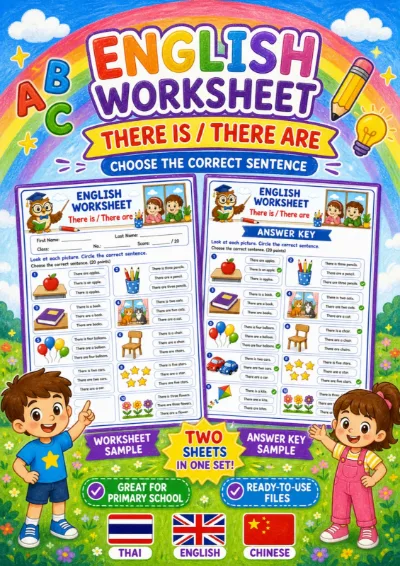
Use the There is / There are, prepositions of place and singular and plural circle-the-answer worksheets, then close with the There is / There are sentence-building version.
Weeks 12 to 14: routines, time and months
Present Simple with he and she is where She like from the opening finally gets fixed. Have children describe their own routine first, I get up at six o'clock., then someone at home, My dad gets up at five o'clock. Seeing the two side by side shows the added s.
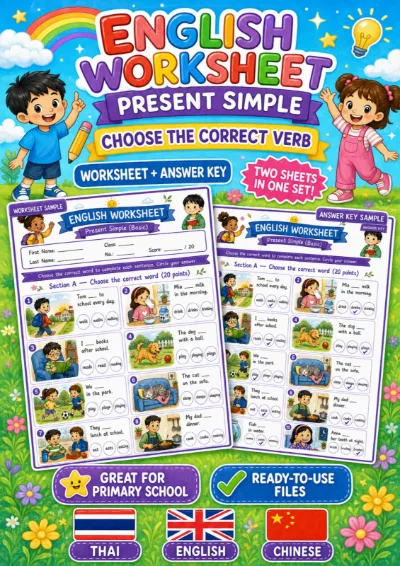
Use all three versions of the basic Present Simple worksheets. The telling time (o'clock) missing-letters and write-the-time sheets and the months of the year sheets are tagged to ต 1.1 ป.3/2 in the shop and follow on in this unit.
Weeks 15 and 16: feelings and likes
ต 1.2 ป.3/5 asks children to say how they feel about familiar things or activities. Use I feel happy. I like drawing. I don't like spiders. Open lessons by letting children pick today's feeling face and say one sentence.
All three like / don't like grammar worksheets are tagged to ต 1.2 ป.3/5. The feelings and emotions first-letter and write-the-word sheets review the unit's vocabulary.
Weeks 17 and 18: ask your own questions, then review
End the term with what, who and where, with children asking rather than answering. Pair them to interview each other using questions from the whole term. All three question words worksheets are tagged to ต 1.2 ป.3/4 in the shop.
During review, run the sorting activity from ต 1.3 ป.3/2: hand out word cards from the whole term and have groups sort them into people, animals and things. With a screen at the front, the AR sets Grade 3 English review: There are, has, must and Grade 3 English review: Does, Can I and do not each close a lesson in five minutes. Both include must and do not, which this plan does not place, so check whether your class has met them.
Common Grade 3 mistakes and what each one tells you
- She have or He like: the verb is known but not tied to the subject. Underline the subject before writing the verb, every time.
- I am go to school.: the child thinks am belongs before every verb, often from drilling I am ... a lot. Compare I am happy. with I go to school. and show that the first has no action verb.
- There is two books.: There is was learned as one chunk. Count first, then decide is or are.
- He can swims.: the -s rule spread to after can. Stress that after can the verb never changes.
- Reads until an unknown word and then stops the whole text: skipping a word has never been practised. Skip it, read the whole sentence, then guess from the picture or the sentences around it.
For parents at home
Grade 3 children are starting to talk about other people in English. Play a guess-who game about family members: your child says two sentences and you guess, He gets up early. He drinks coffee. If your child says He get up, do not stop the game to correct. Repeat the correct form when you guess, Yes, he gets up early. It's Grandpa! Your child hears the right form without feeling caught out.
Worksheets from this article
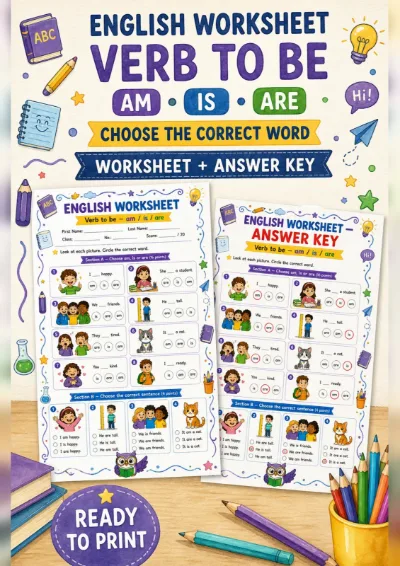
Grades 1–3 (P.1–P.3)
Verb to be am is are worksheet
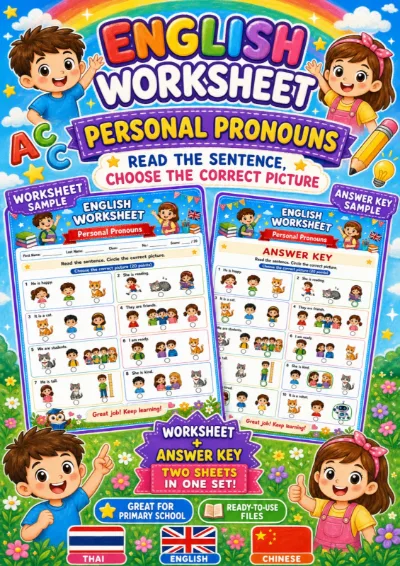
Grades 1–3 (P.1–P.3)
Personal Pronouns - Read and Choose the Picture
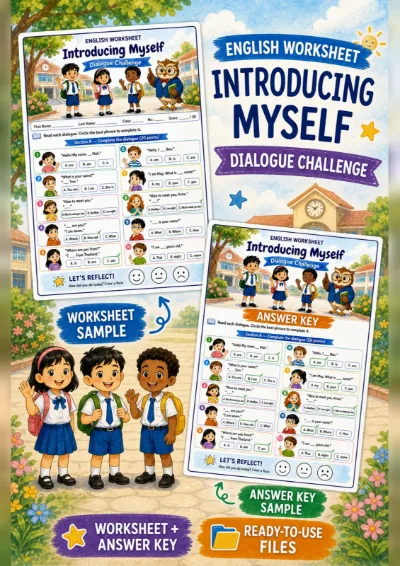
Grades 1–3 (P.1–P.3)
Introducing Myself - Read the Dialogue and Circle the Correct Phrase
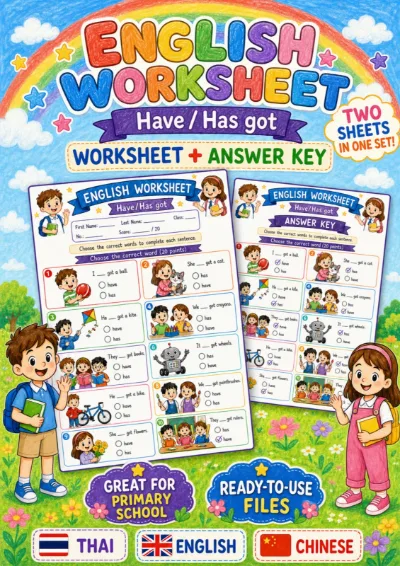
Grades 1–3 (P.1–P.3)
Have / Has got - Choose the Correct Word
Grades 1–3 (P.1–P.3)
There is / There are - Circle the Correct Sentence
Grades 1–3 (P.1–P.3)