

Plenty of Grade 5 children score full marks on a Past Simple worksheet, then write Yesterday I go to the market. when asked what they did yesterday. The problem is not that they do not know the rule. They know it on a worksheet that already tells them the item is in the past, but they have never had to choose the tense themselves in their own writing.
The Thai core curriculum moves Grades 4 to 6 from words and short sentences to reading short texts and answering questions, writing about familiar topics, and a cumulative vocabulary of about 1,050 to 1,200 words by the end of Grade 6. This article arranges Krufahda's Grade 4 to 6 worksheets into three lines, tense, description, and reading with writing, and shows where they connect. The grade for each topic varies with the textbook, so treat this as an order, not a fixed timetable.
Line 1: tense, starting with what children do every day
Thai verbs do not change form for time. Thai marks time with words such as แล้ว, กำลัง and จะ. Thai children therefore need practice noticing that English verbs change form. The order that works is to start with what children do every day.
First use the Daily Routines worksheet, matching pictures to words, so the verbs are ready: get up, brush my teeth, go to school. Then the Adverbs of Frequency worksheet, reading a frequency bar and choosing always, usually or never. Children end up with sentences like I usually get up at six., a Present Simple sentence with real meaning rather than a stray example.
Present Continuous, then comparing the two tenses
Once children can talk about routines, teach what is happening now. Use the Present Continuous worksheet, choosing the right sentence for a picture. The point to stress is that am, is or are is always there, because Thai children often write She running., following the Thai structure เธอ กำลัง วิ่ง, which has no helping verb.
Then use the Present Simple vs Continuous worksheet, choosing the sentence that matches the picture. This sheet matters more than the two before it, because it is the first time children choose the tense themselves. Ask them to find the time words before answering: every day points to Present Simple, now or at the moment points to Present Continuous.
The past: was and were before regular and irregular verbs
The suggested order is was and were first, then regular verbs, then irregular verbs. Was and were appear in sentences children say often, such as I was sick. It was hot., and they do not require learning a new verb form for every word. Use the Past of To Be worksheet, choosing was or were for each picture.
Regular verbs add -ed, which has three pronunciations: /t/ in walked, /d/ in played and /ɪd/ in wanted. Have children hear and sort the sounds, not just write them. Use the Past Simple Regular Verbs worksheet, then the Past Simple Irregular Verbs worksheet. Irregular verbs do not need a long list to memorise. Start with the ones used most in storytelling, such as went, ate, saw, had and got.
Past negatives and questions are a frequent stumbling point, as in I didn't went. The rule to stress is that once did or didn't is there, the main verb returns to its base form: I didn't go.
The future: going to and will are not always interchangeable
The Future with Going To worksheet has children read a sentence and choose the picture that matches a future plan. The Future with Will worksheet has them read a sentence and choose the matching picture. For Grades 4 to 6, a simple split works: going to is for something already planned, such as I'm going to visit my grandma this weekend., and will is for a decision made while speaking, such as It's cold. I'll close the window., and for general predictions.
You can teach going to before will, because it uses am, is and are, which children already know from Present Continuous.
Line 2: description, with adjectives, comparatives, superlatives and linking words
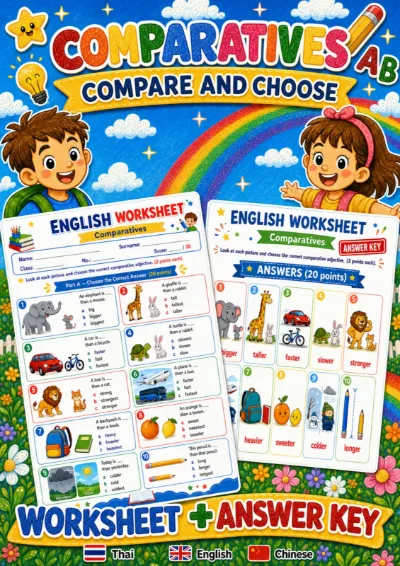
This line takes children from saying what something is like to comparing and giving reasons. Use the Comparatives worksheet, choosing bigger, taller or faster, then the Superlatives worksheet, choosing biggest, tallest or fastest.
There are three spelling rules to teach in full. One-syllable words ending in a short vowel and a single consonant double the final consonant, so big becomes bigger. Words ending in y change it to i, so happy becomes happier. Longer adjectives use more or most, as in more beautiful. The common error more bigger uses both methods at once.
Close this line with the Conjunctions worksheet, circling and, but or because. Because is the doorway to opinion writing in line 3.
Line 3: read a text type, then write the same type
Grade 4 to 6 writing improves fastest when children read an example of the same kind of text before writing. The reading and writing worksheets pair up like this.
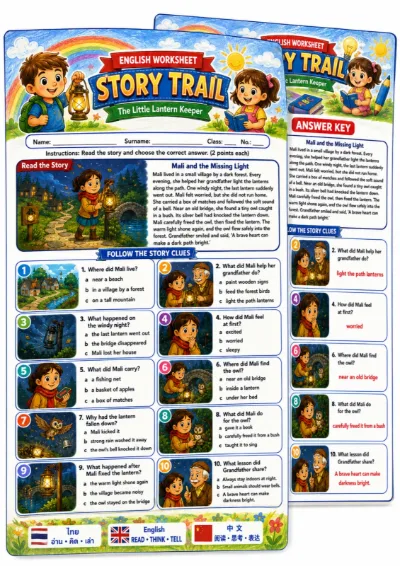
- Stories: read the Stories and Narratives worksheet, Mali and the Missing Light, then write with the Short Narrative worksheet, which plans who, where and what happened. It sits neatly alongside the past-tense line
- Emails: read the Emails and Letters worksheet, an email from the school garden club, then write with the Personal Letters and Emails worksheet, which completes a model email and then writes a reply to a friend
- Diaries: the Diary Entries worksheet retells a routine from pictures and then writes five sentences to a frame, reviewing Present Simple and Past Simple in one task
- Opinions: the Opinion Sentences worksheet uses I think, I like and because, following on from the conjunctions sheet
A suggested order across three years
If your school has not set an order, the one below lets each grade build on the one before.
- Grade 4: daily routines, adverbs of frequency, Present Continuous and comparing the two tenses, paired with simple diary writing
- Grade 5: was and were, regular verbs, irregular verbs, paired with reading stories and writing short narratives
- Grade 6: comparatives, superlatives, the future and conjunctions, paired with reading and writing emails and opinion writing
Mistakes Thai learners make most, and where to go back
Most Grade 4 to 6 mistakes come from Thai structure carried over, not from carelessness.
- He go to school., with no s for a third-person singular subject: Thai has no such rule. Have children underline the subject before writing the verb, every time
- She running., with no am, is or are: go back to the Present Continuous worksheet and always practise is and -ing as a pair
- Yesterday I go ..., using the base form in the past: the child knows the rule but has not chosen the tense. Ask them to circle the time words in their own sentences before handing in
- I didn't went., marking the past twice: stress that did has already done the job of marking the past
- more bigger, using two methods at once: have children count the syllables of the adjective before choosing -er or more
Check each unit with short writing, not another worksheet
A multiple-choice worksheet tells you a child knows the rule, not that they can use it. At the end of each unit, ask children to write three sentences about themselves with the new structure, such as three things they did at the weekend or three things they will do in the holidays. You can read the whole class in a few minutes and see at once who now chooses the tense themselves and who needs to go back a worksheet.
Worksheets from this article
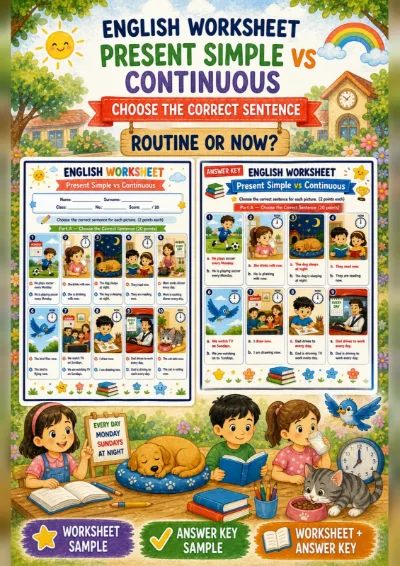
Grades 4–6 (P.4–P.6)
Present Simple vs Continuous worksheet
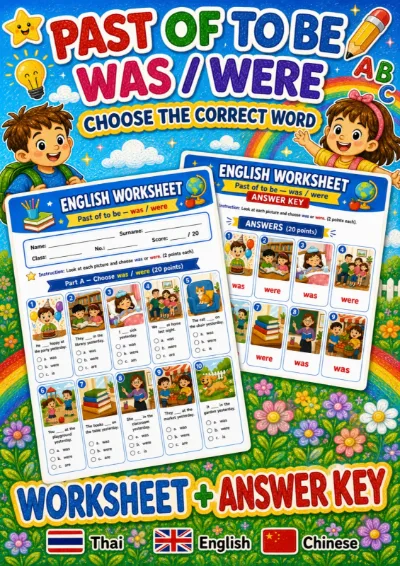
Grades 4–6 (P.4–P.6)
Past of to be worksheet
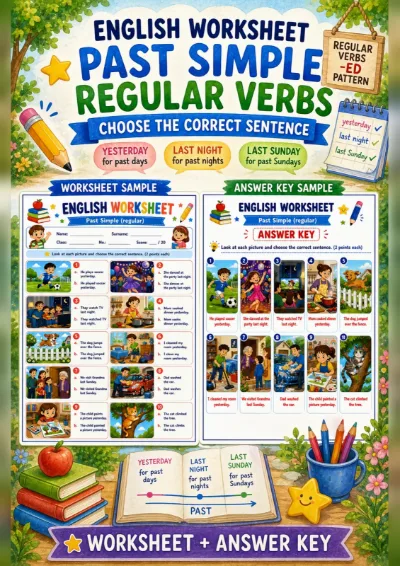
Grades 4–6 (P.4–P.6)
Past Simple regular worksheet
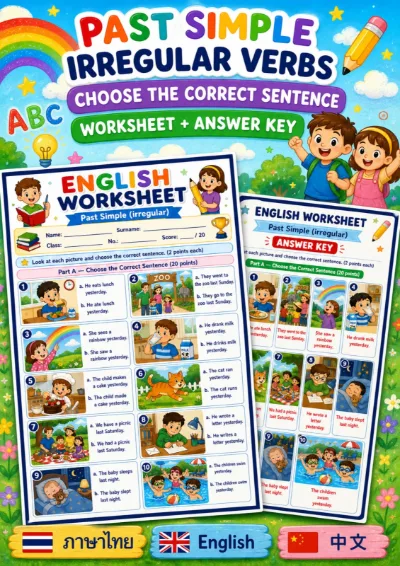
Grades 4–6 (P.4–P.6)
Past Simple irregular worksheet
Grades 4–6 (P.4–P.6)
Comparatives - Look at the Picture and Choose Bigger, Taller or Faster
Grades 4–6 (P.4–P.6)