

Many teachers pick maths worksheets by the topic they are teaching, which is fine, but a child often fails the change-giving sheet because they cannot yet subtract across ten, or misreads a ruler because they do not understand that the numbers on it are distances from zero. Every maths worksheet has another skill hidden underneath it.
The Thai core curriculum, revised in 2017 (B.E. 2560), splits primary maths into three strands, number and algebra, measurement and geometry, and statistics and probability, and widens the number range every year: within 100 in Grade 1, within 1,000 in Grade 2 and within 100,000 in Grade 3. This article arranges Krufahda's Grade 1 to 3 maths worksheets by strand, shows what each one builds on, and which mistakes mean a step back.
Number: counting, place value and comparing
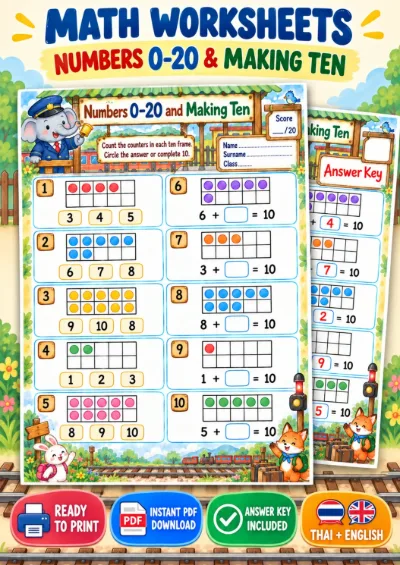
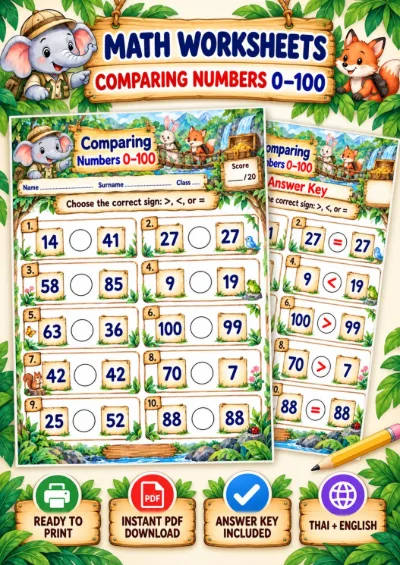
Everything in Grade 1 to 3 maths rests on knowing how many tens and ones make up a number. The suggested order is Count 0-10, Numbers 0-20 and Making Ten, Number Order 0-100, and then Comparing Numbers 0-100, where children choose the comparison sign.
The making-ten sheet matters more than it looks. A child who knows instantly that 7 needs 3 more to make 10 will find adding and subtracting across ten far easier later. Before comparing two-digit numbers, project the Place Value 0-100 teaching media so children see that 47 is four tens and seven ones. Once they see that, they compare 47 and 74 by the tens first, instead of noticing only that both contain a 7.
Addition, subtraction and missing numbers
Addition Within 10, Subtraction Within 100 in columns, and Mixed Addition and Subtraction, where children choose the sign, can go in that order. For the detail of carrying and borrowing, see Krufahda's step-by-step article on teaching addition and subtraction in Grades 1 to 3.
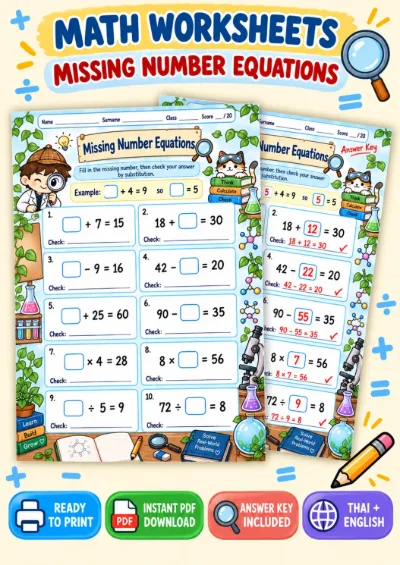
The Missing Number Equations sheet needs a different understanding. Faced with 8 + ☐ = 15, quite a few children answer 23, because they read = as the answer comes next rather than both sides are equal. Have children read the problem aloud as eight plus what makes fifteen, and after answering, put the number back in to check. The sheet already has a solve-and-check step, so do not skip the check.
Patterns and skip counting: the bridge to multiplication and division
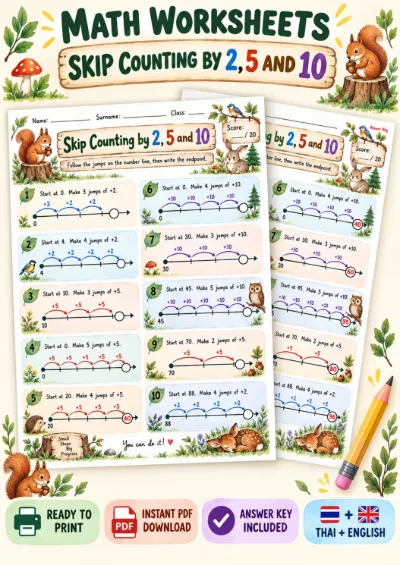
Number Patterns and Skip Counting by 2, 5 and 10 on a Number Line prepare children for times tables before they know it. Counting 5, 10, 15, 20 is the 5 times table. When multiplication starts, point back to the number line: 4 × 5 is four jumps of 5.
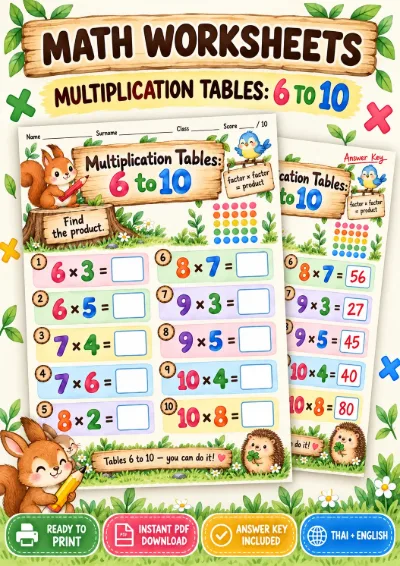
The 2 to 5 tables are usually learned first through this kind of skip counting. Once children are fluent, use Multiplication Tables 6-10, then Division Facts, matching quotients. Always teach division alongside multiplication: for 24 ÷ 6, ask what times 6 makes 24. Children who can recite tables but cannot divide have usually never seen that the two are the same set of facts.
Fractions: start with equal sharing
Equal Parts: Halves, Thirds and Quarters asks children to shade and choose. The heart of the sheet is the word equal. A shape split into two unequal parts with one shaded is not a half. Have children fold real paper first, and they will see that only parts that fit exactly on top of each other count as equal.
Comparing Simple Fractions has a well-known trap: children say 1/4 is bigger than 1/2 because 4 is bigger than 2. Go back to the folded paper: share the same cake among more people and each piece gets smaller. Under the 2017 revised curriculum, fractions are formally taught in Grade 3, so these two sheets suit Grade 3, or late Grade 2 where the school has started laying the groundwork.
Measurement: length, capacity and time
Measurement is where the same mistakes repeat most. Each sheet has a point to watch.
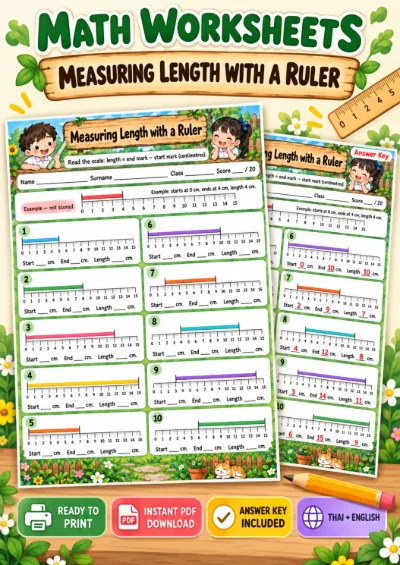
- Measuring Length, Read a Ruler: children start counting from 1, or from the edge of the ruler, instead of from 0. Ask what the numbers on a ruler tell you. The answer is the distance from zero, not the number of the box
- Capacity, Read Water Levels: get eyes level with the water surface, and check what each gap between marks is worth before reading the number
- Telling Time, O'clock and Half Past: at half past, the hour hand sits between two numbers, and children often read whichever number it is closer to. Stress that the hour hand has not reached the next number, so the hour has not changed yet
- Telling Time, Quarter Past and Quarter To: follows the previous sheet once children can count minutes in fives, which is the skip counting by 5 from the patterns topic
- Calendar Skills: use the real class calendar alongside it and ask questions children care about, such as which day a friend's birthday falls on, or how many days until the holiday
Money: from real coins to baht and satang
Order the money sheets as Thai Money: Coins and Banknotes, counting money, then Shopping and Change, then Money Decimals: Baht and Satang, reading and adding amounts. Before the first sheet, let children handle real or toy coins. Some children believe a bigger coin is always worth more.
Change can be worked out in two ways: subtract directly, or count up from the price to the amount paid, the way market sellers do. Something costs 35 baht and you pay 50: count from 35 to 40, that is 5, then to 50, another 10, so the change is 15 baht. Children who cannot yet subtract across ten find counting up easier. The baht and satang sheet needs 100 satang = 1 baht, and 12.50 baht read as twelve baht fifty satang. There is no need to explain the point as a decimal yet. Teach it as the mark between baht and satang. Decimals come later, in Grade 4.
Geometry: shapes around us and lines of symmetry
3D Shapes, matching shapes to objects, works from Grade 1. Have children find real objects in the room first: a chalk box is a cuboid, a can is a cylinder, a ball is a sphere. Lines of Symmetry, drawing the line, suits Grade 3. Have children fold the paper along the line they drew first. If the two halves fit exactly, it is a line of symmetry. Children often draw a diagonal on a rectangle, and folding shows them it is not one.
Angles Around Us and Area on a Grid cover content the curriculum places in Grade 4. Use them with ready Grade 3 children, or as review at the start of Grade 4.
Statistics: sort, count, then read charts
Children read charts better once they have made data themselves. Start with Sorting and Classifying Data, sorting and counting, then Pictographs, reading a pictograph, and Bar Graphs, reading a bar graph.
The most common pictograph mistake is counting pictures without checking what one picture stands for. If one picture means 2 people, a row of 4 pictures is 8 people. Before every question, have children circle the line that says what one picture is worth. The Chance sheet, judging certain, impossible, likely and unlikely, is not core Grade 1 to 3 content, but works as an extension activity for reasoning.
Choose the sheet for the child, not for the textbook page
Every maths worksheet comes with Thai instructions and English instructions, plus an answer key. Regular classes use the Thai edition, and EP or MEP classes can use the English edition without translating anything. Before choosing, ask yourself three questions.
- What skill sits underneath this sheet? Change needs subtraction, telling time needs counting in fives
- Can the child already do that underlying skill? If not, use the sheet that comes before it in this article
- Is the sheet for teaching, practice or checking? If it is a check, have children do half the sheet and look at the mistakes, there is no need to wait for them to finish
For parents at home
Grade 1 to 3 maths can be practised in daily life more than you might think. Let your child count the change when buying a snack, read the clock for when you leave home, or share snacks equally between siblings. If your child gets stuck on a worksheet, ask them to tell you how they worked it out instead of giving the answer. Children often find their own mistake while explaining.
Worksheets from this article
Grades 1–3 (P.1–P.3)
Numbers 0-20 and Making Ten - Count and Make Ten
Grades 1–3 (P.1–P.3)
Comparing Numbers - Choose the Sign
Grades 1–3 (P.1–P.3)
Missing Number Equations - Solve and Check
Grades 1–3 (P.1–P.3)
Skip Counting by 2, 5 and 10 - Skip Count on a Number Line
Grades 1–3 (P.1–P.3)
Multiplication Tables 6-10 - Find the Product
Grades 1–3 (P.1–P.3)