
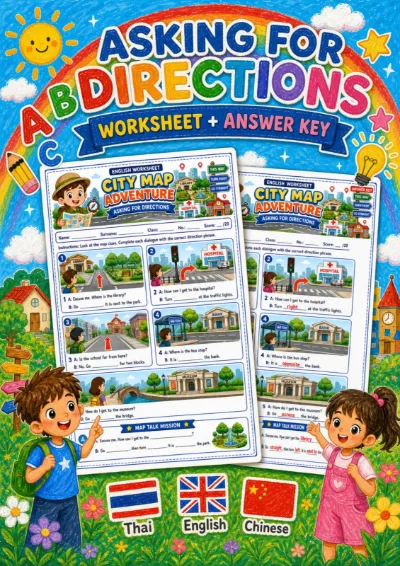
Grades 4–6 (P.4–P.6)
Asking for directions worksheet
19 Baht
View detailsEnglish
An AR classroom game for Grade 4. Learners can aim with their hands at the camera or play by tapping the screen.
This set has 4 rounds in an interactive sorting activity.
Curriculum indicatorต 1.1 ป.4/2
A look before you play
A few real prompts from the game to help you choose an activity for your class.
Sort into
A noun is the name of a thing; a verb is an action.
Sort into
A singular pronoun stands for one person, a plural one for several.
Sort into
Auxiliaries build questions and negatives; ordinary verbs name the action.
Before you play
Sort word types: nouns vs verbs, singular vs plural pronouns, auxiliaries (do, can) vs ordinary verbs, and statements vs questions (indicator ต 1.1 ป.4/2).
4 questions, sorting into 2 groups - teacher, school are nouns; run, write are verbs - he, she are singular; they, we are plural - do, can are auxiliaries; eat, swim are ordinary verbs - I like cats. is a statement; Do you like cats? is a question
Use when starting word types, about 5 minutes, solo. Q3 is the hardest; its result tells you whether auxiliaries need more teaching. - For Q4, children notice that questions start with Do or Is and end with ? - In Q3, explain that do can also be a main verb (I do my homework.) but counts as an auxiliary here - Play it linked to your class so scores go into the gradebook
- do (Q3) is dragged to ordinary verbs, as children know it means ทำ, an action - can (Q3): some put it with ordinary verbs because it means สามารถ - school (Q1) is rarely missed, but teacher may cause hesitation because it comes from the verb teach
Grades 4–6 (P.4–P.6)
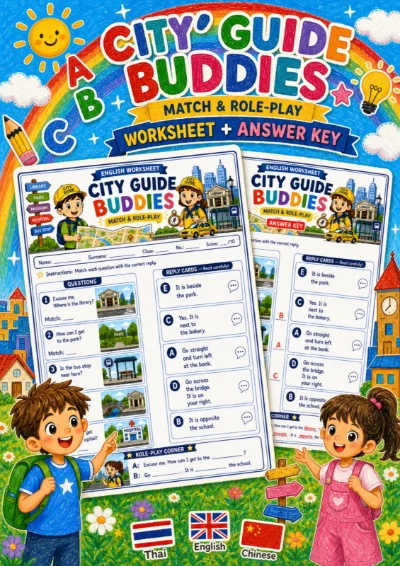
Grades 4–6 (P.4–P.6)
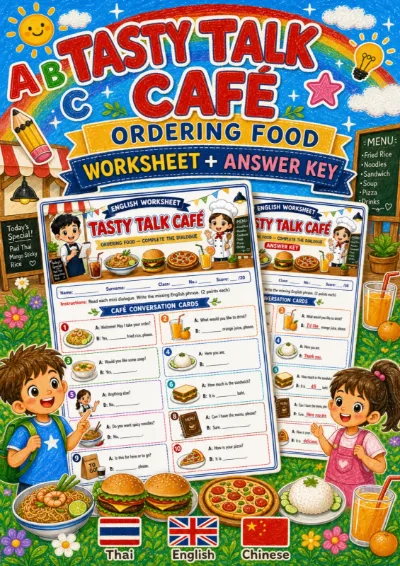
Grades 4–6 (P.4–P.6)

Grades 4–6 (P.4–P.6)
 Matching
EnglishGrade 14 rounds
 Multiple choice
EnglishGrade 16 questions
 Sorting
EnglishGrade 14 rounds
 Ordering
EnglishGrade 14 rounds