
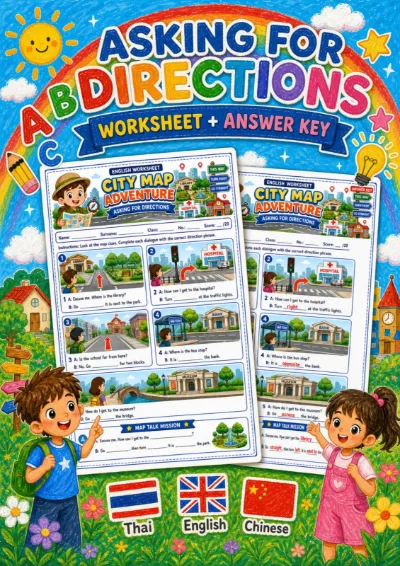
Grades 4–6 (P.4–P.6)
Asking for directions worksheet
19 Baht
View detailsEnglish
An AR classroom game for Grade 6. Learners can aim with their hands at the camera or play by tapping the screen.
This set has 4 rounds in an interactive sorting activity.
Curriculum indicatorต 1.2 ป.6/1
A look before you play
A few real prompts from the game to help you choose an activity for your class.
Sort into
Some verbs are followed by "ing" and some by "to".
Sort into
Separate sentences where the subject acts from ones where it is acted on.
Sort into
Separate what helps the environment from what harms it.
Before you play
Practise sorting harder grammar: verbs followed by -ing versus to, active versus passive, actions that help or harm the environment, and countable versus uncountable nouns (ต 1.2 ป.6/1).
4 sorting questions - enjoy and finish take -ing; want and decide take to - They clean the room. versus The room is cleaned. - recycle and save water versus pollute and waste energy - bottle and tree are countable; plastic and air are not
Use in the P6 environment unit, 5 minutes in team mode. - For item 1, have pupils say real sentences, I enjoy reading. I want to read., to hear the difference - After item 3, each team suggests one more way to help the planet - For item 4, explain that plastic as a material is uncountable, but a plastic bottle is countable Play it linked to a class and the results go into the mark book.
- Item 1: putting decide with -ing by guessing from meaning; there is no rule, these are learnt one by one - Item 4: putting plastic with countables, thinking of plastic bags one by one - Item 2: calling The room is cleaned. active, missing is + past participle
Grades 4–6 (P.4–P.6)
Grades 4–6 (P.4–P.6)
Grades 4–6 (P.4–P.6)
Grades 4–6 (P.4–P.6)
 Matching
EnglishGrade 14 rounds
 Multiple choice
EnglishGrade 16 questions
 Sorting
EnglishGrade 14 rounds
 Ordering
EnglishGrade 14 rounds