
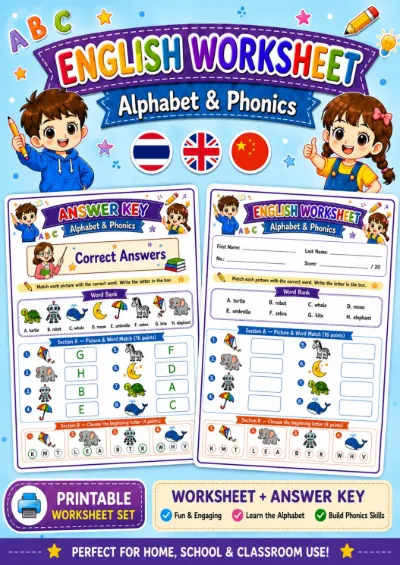
Grades 1–3 (P.1–P.3)
Alphabet & Phonics - Picture and Word Match
19 Baht
View detailsEnglish
An AR classroom game for Grade 1. Learners can aim with their hands at the camera or play by tapping the screen.
This set has 4 rounds in an interactive sorting activity.
Curriculum indicatorต 1.1 ป.1/2
A look before you play
A few real prompts from the game to help you choose an activity for your class.
Sort into
Separate morning activities from night-time ones.
Sort into
Separate greetings from farewells.
Sort into
Separate what you wear from what you eat.
Before you play
Practise morning and night routine words (wake up, eat breakfast, sleep, say good night), greetings versus farewells, and sorting other words by meaning.
4 sorting rounds, dragging 4 cards into 2 groups - Morning or night: wake up, sleep, eat breakfast, say good night - Greeting or farewell: Hello, Goodbye, Good morning, See you - Wear it or eat it: shirt, rice, shoes, apple - Living or non-living: cat, chair, tree, book
Use after children have talked about their daily routine; about 4 minutes. - Play in teams; in round 1 have teams act waking up, eating and sleeping - In round 2, greet and say goodbye to a neighbour with the card phrases - In round 4, discuss why a tree is living (it grows) - Play it linked to the class to record results in the mark book.
- Round 4: tree often goes under non-living because trees do not move - Round 2: See you may go with greetings because children read it as meeting - Round 1: say good night may go under morning because it has good, like Good morning
Grades 1–3 (P.1–P.3)
Grades 1–3 (P.1–P.3)
Grades 1–3 (P.1–P.3)
Grades 1–3 (P.1–P.3)
 Matching
EnglishGrade 14 rounds
 Multiple choice
EnglishGrade 16 questions
 Sorting
EnglishGrade 14 rounds
 Ordering
EnglishGrade 14 rounds