
Grades 1–3 (P.1–P.3)
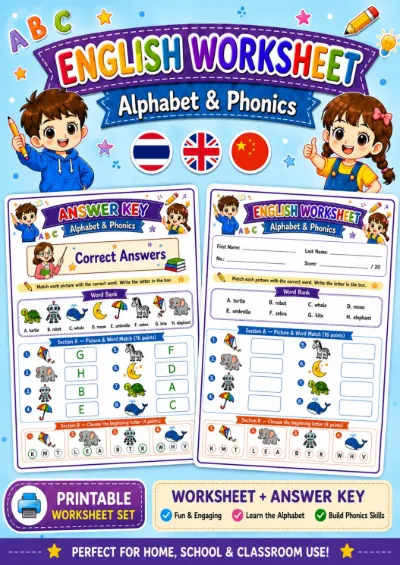
Alphabet & Phonics - Picture and Word Match
19 Baht
View detailsEnglish
An AR classroom game for Grade 2. Learners can aim with their hands at the camera or play by tapping the screen.
This set has 6 questions in an interactive multiple choice activity.
Curriculum indicatorต 1.2 ป.2/1
A look before you play
A few real prompts from the game to help you choose an activity for your class.
"Can" says what you are able to do, and the verb after it never changes form.
"Cannot" says what is not possible - a fish cannot walk.
After "can" the verb keeps its plain form: "ride".
Before you play
Use can and cannot to talk about ability, ask Can you ...? and keep the base verb after can (ride, sing), for short exchanges in indicator ต 1.2 ป.2/1.
6 questions, multiple choice focusing on form - A fish ___ walk. Answer: cannot - I can ___ a bicycle. Answer: ride (not rides or riding) - ___ you swim? Answer: Can - Cats ___ climb trees. Answer: can (not cans)
Use after the animal-abilities game or after teaching can + verb, about 5 minutes. Play solo to spot who still adds s after can. - After ___ you swim?, pair children to ask and answer for real: Can you swim? Yes, I can. / No, I can't. - On a question many miss, write can + plain verb on the board and point back to it - Play it linked to your class to log scores in the gradebook
- She can ___ very well (Q5): picking sings because she usually takes -s. Stress that nothing is added after can, even with she - Cats ___ climb trees (Q6): picking cans because Cats is plural. Can never changes form - ___ you swim? (Q4): picking Do, familiar from other lessons. Point out the question asks about ability
Grades 1–3 (P.1–P.3)
Grades 1–3 (P.1–P.3)
Grades 1–3 (P.1–P.3)
Grades 1–3 (P.1–P.3)
 Matching
EnglishGrade 14 rounds
 Multiple choice
EnglishGrade 16 questions
 Sorting
EnglishGrade 14 rounds
 Ordering
EnglishGrade 14 rounds