
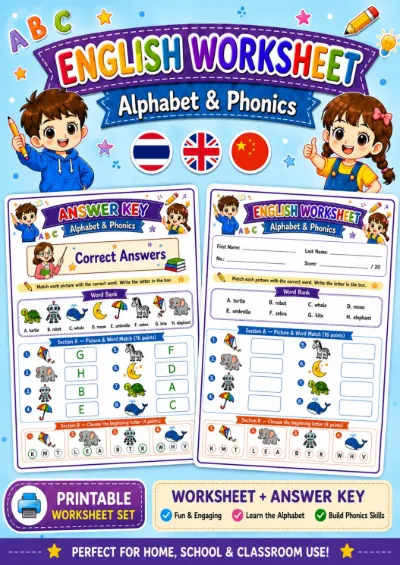
Grades 1–3 (P.1–P.3)
Alphabet & Phonics - Picture and Word Match
19 Baht
View detailsEnglish
An AR classroom game for Grade 2. Learners can aim with their hands at the camera or play by tapping the screen.
This set has 4 rounds in an interactive matching activity.
Curriculum indicatorต 1.1 ป.2/2
A look before you play
A few real prompts from the game to help you choose an activity for your class.
The words for your closest family.
English does not separate older from younger siblings - you add "older" or "younger".
Sentences for introducing your family to someone.
Before you play
Read words for family members and relatives, match questions to answers when introducing a family, and understand my, your, his and her (indicator ต 1.1 ป.2/2).
4 questions, matching 4 pairs each - brother to พี่ชายหรือน้องชาย, sister to พี่สาวหรือน้องสาว - grandmother to ย่าหรือยาย, uncle to ลุงหรืออา - Who is this? to This is my mother. and What is his job? to He is a farmer. - his to ของเขาผู้ชาย, her to ของเธอ
Use before children introduce their own families, about 5 minutes. Play in pairs, then have each pair ask and answer with the Q3 questions straight away. - For relatives, explain that English uses one word, uncle, for ลุง, อา and น้า on the male side - If his and her go badly, point to a boy and say his book, a girl and say her book - Be mindful of children whose families differ; let them talk about whoever they choose - Play it linked to your class so scores go into the gradebook
- his and her (Q4) are often swapped because Thai ของเขา can mean either - uncle and aunt (Q2): a child who calls a male relative น้า or a female one อา may hesitate, as the game's translations leave those out - How many brothers? (Q3) is not a full sentence; read it as How many brothers do you have?
Grades 1–3 (P.1–P.3)
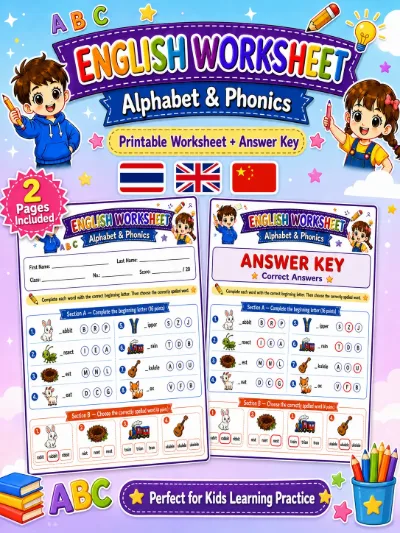
Grades 1–3 (P.1–P.3)
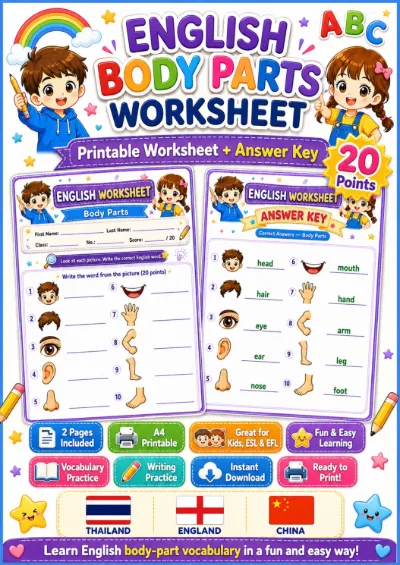
Grades 1–3 (P.1–P.3)
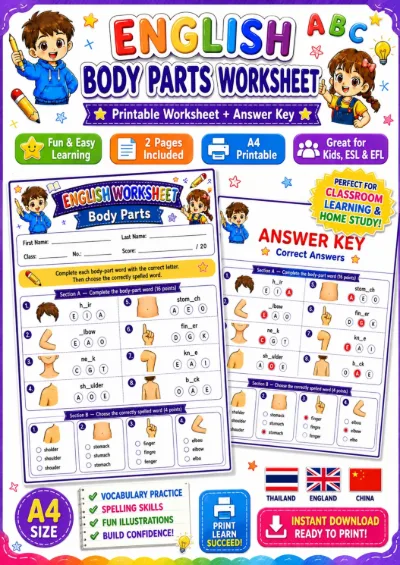
Grades 1–3 (P.1–P.3)
 Matching
EnglishGrade 14 rounds
 Multiple choice
EnglishGrade 16 questions
 Sorting
EnglishGrade 14 rounds
 Ordering
EnglishGrade 14 rounds