
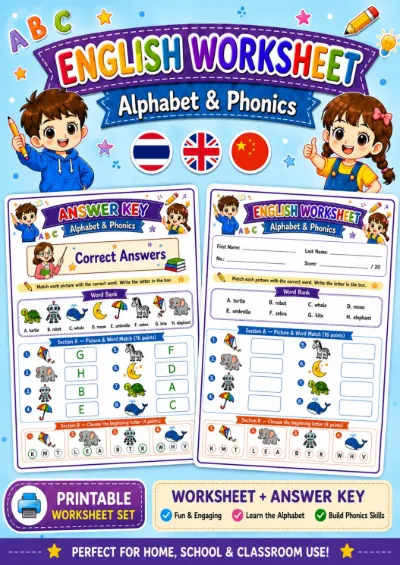
Grades 1–3 (P.1–P.3)
Alphabet & Phonics - Picture and Word Match
19 Baht
View detailsEnglish
An AR classroom game for Grade 3. Learners can aim with their hands at the camera or play by tapping the screen.
This set has 6 questions in an interactive multiple choice activity.
Curriculum indicatorต 1.2 ป.3/1
A look before you play
A few real prompts from the game to help you choose an activity for your class.
"Must" says what has to be done - a rule.
"Must not" is an absolute ban, stronger than "should not".
"Can" says what you are able to do; "must" says what you have to do.
Before you play
Tell apart can (able to), must (have to), must not (not allowed) and should (advice) to talk about class rules and ability, and know that the verb after them stays in its plain form (indicator ต 1.2 ป.3/1).
6 questions, multiple choice with 3 options - You ___ wash your hands before eating. Answer: must - You ___ not run in the classroom. Answer: must - I ___ speak English a little. Answer: can - You ___ sleep early. Answer: should
Use early in the term while agreeing class rules, about 6 minutes, whole class; then children write their own rules with must, must not and should. - Make three colour cards (must red, should yellow, can green) and hold one up for each question - On You ___ not run, if a child picks can, acknowledge the sentence works, then explain must not is firmer and suits a rule - Play it linked to your class so scores go into the gradebook
- You ___ not run in the classroom (Q2): choosing can, since can not also means not allowed in speech - We ___ be quiet in the library (Q6): cans and musts are obviously wrong, so most get it right, but that does not show they can tell should from must - You ___ sleep early (Q4): choosing must not after skimming. Translate the whole sentence before choosing
Grades 1–3 (P.1–P.3)
Grades 1–3 (P.1–P.3)
Grades 1–3 (P.1–P.3)
Grades 1–3 (P.1–P.3)
 Matching
EnglishGrade 14 rounds
 Multiple choice
EnglishGrade 16 questions
 Sorting
EnglishGrade 14 rounds
 Ordering
EnglishGrade 14 rounds