
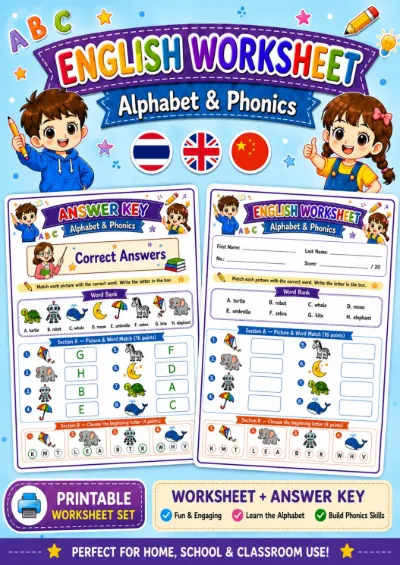
Grades 1–3 (P.1–P.3)
Alphabet & Phonics - Picture and Word Match
19 Baht
View detailsEnglish
An AR classroom game for Grade 3. Learners can aim with their hands at the camera or play by tapping the screen.
This set has 4 rounds in an interactive matching activity.
Curriculum indicatorต 1.1 ป.3/2
A look before you play
A few real prompts from the game to help you choose an activity for your class.
Monday to Wednesday - every one ends in "day".
Friday to Sunday; Saturday and Sunday together are the weekend.
Month names in English always start with a capital letter.
Before you play
Read all seven day names, some month names and the time words today, yesterday, tomorrow, week and weekend, and match them to Thai (indicator ต 1.1 ป.3/2).
4 questions, matching 4 pairs each - Tuesday to วันอังคาร, Thursday to วันพฤหัสบดี - Saturday to วันเสาร์, weekend to วันหยุดสุดสัปดาห์ - April to เมษายน, August to สิงหาคม, December to ธันวาคม - yesterday to เมื่อวาน, week to สัปดาห์
Can be a daily starter, about 4 minutes, in pairs. Use Thai mode: English mode shows the same word on both sides. - After Q3, ask What month is it now? and have them answer in English - After Q4, practise Today is ... Yesterday was ... Tomorrow is ... - Play it linked to your class so scores go into the gradebook
- Tuesday and Thursday (Q1) are the most swapped pair. Thursday has the h and sits next to Friday - yesterday and tomorrow (Q4) get swapped as both are not today. Point back and forward - week and weekend (Q2, Q4) may look like one word. Show that end means the last part
Grades 1–3 (P.1–P.3)
Grades 1–3 (P.1–P.3)
Grades 1–3 (P.1–P.3)
Grades 1–3 (P.1–P.3)
 Matching
EnglishGrade 14 rounds
 Multiple choice
EnglishGrade 16 questions
 Sorting
EnglishGrade 14 rounds
 Ordering
EnglishGrade 14 rounds