
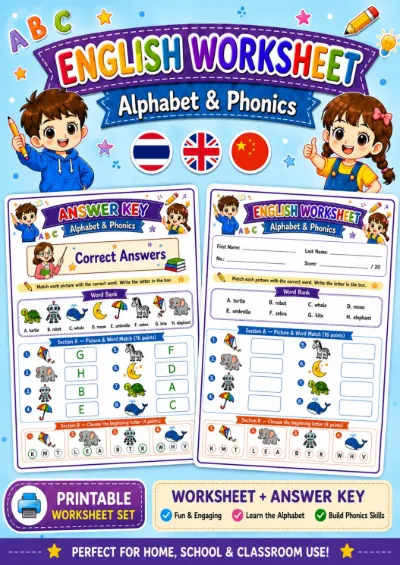
Grades 1–3 (P.1–P.3)
Alphabet & Phonics - Picture and Word Match
19 Baht
View detailsEnglish
An AR classroom game for Grade 3. Learners can aim with their hands at the camera or play by tapping the screen.
This set has 4 rounds in an interactive matching activity.
Curriculum indicatorต 1.1 ป.3/2
A look before you play
A few real prompts from the game to help you choose an activity for your class.
Food from the school menu.
Linking taste words to real food.
Sentences for mealtimes.
Before you play
Read food and tableware words, taste words (sweet, sour, salty, spicy) and phrases used at mealtimes such as I am full. and No, thank you. (indicator ต 1.1 ป.3/2).
4 questions, matching 4 pairs each - pork to หมู, vegetable to ผัก - sour to lemon, salty to chips, spicy to chilli - I am full. to having eaten enough, No, thank you. to refusing politely - plate to จาน, bowl to ชาม
Use just before lunch, about 5 minutes, in pairs; then pairs practise Would you like some rice? No, thank you. I am full. - For tastes, a lime or some salt on the desk helps sour and salty stick - For tableware, point to children's real plates and bowls at lunch - Play it linked to your class so scores go into the gradebook
- plate and bowl (Q4) get swapped; a plate is flat, a bowl is deep - sour and salty (Q2) both start with s; match lemon first, as it is the clearest - pork (Q1): children may not know it is pig meat, having only learned pig
Grades 1–3 (P.1–P.3)
Grades 1–3 (P.1–P.3)
Grades 1–3 (P.1–P.3)
Grades 1–3 (P.1–P.3)
 Matching
EnglishGrade 14 rounds
 Multiple choice
EnglishGrade 16 questions
 Sorting
EnglishGrade 14 rounds
 Ordering
EnglishGrade 14 rounds