
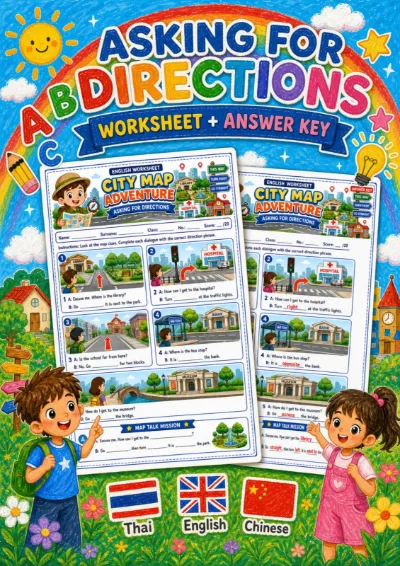
Grades 4–6 (P.4–P.6)
Asking for directions worksheet
19 Baht
View detailsEnglish
An AR classroom game for Grade 4. Learners can aim with their hands at the camera or play by tapping the screen.
This set has 4 rounds in an interactive matching activity.
Curriculum indicatorต 1.1 ป.4/2
A look before you play
A few real prompts from the game to help you choose an activity for your class.
Adjectives come in opposite pairs; learn the pair and you have both words at once.
"Long" and "short" are for length; "tall" and "short" are for height.
Many job names come from the work itself - "teacher" from "teach".
Before you play
Match adjectives with their opposites (fast and slow, easy and difficult), then review jobs and workplaces and basic question-answer pairs such as Where are you from? (indicator ต 1.1 ป.4/2).
4 questions, matching 4 pairs each - fast to slow, old to new - long to short, easy to difficult - farmer to farm, cook to kitchen - Where are you from? to I am from Thailand.
Use at the start of an adjectives unit, about 5 minutes, in teams. For Q1 and Q2, teams act out the opposites, such as walking fast and then slowly. - Q2 pairs tall with low, which is wrong; tell children beforehand that the opposite of tall is short and low pairs with high - After Q4, children ask and answer the four questions for real - Play it linked to your class so scores go into the gradebook
- tall and low (Q2): children who know tall pairs with short are confused because short is already used with long. The game is at fault, not the child - old and new (Q1): some think old pairs with young, which is also right, but young is not offered - What time is it? (Q4): matched with I am ten years old. because both answers have a number
Grades 4–6 (P.4–P.6)
Grades 4–6 (P.4–P.6)
Grades 4–6 (P.4–P.6)

Grades 4–6 (P.4–P.6)
 Matching
EnglishGrade 14 rounds
 Multiple choice
EnglishGrade 16 questions
 Sorting
EnglishGrade 14 rounds
 Ordering
EnglishGrade 14 rounds