
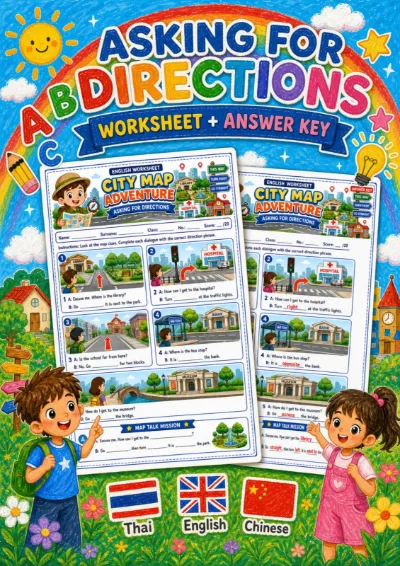
Grades 4–6 (P.4–P.6)
Asking for directions worksheet
19 Baht
View detailsEnglish
An AR classroom game for Grade 5. Learners can aim with their hands at the camera or play by tapping the screen.
This set has 4 rounds in an interactive matching activity.
Curriculum indicatorต 1.2 ป.5/1
A look before you play
A few real prompts from the game to help you choose an activity for your class.
Irregular verbs have to be learnt in pairs, because adding "ed" will not get you there.
This group changes the vowel in the middle; learning them as a group beats one at a time.
A past-time word tells you the sentence needs the past form.
Before you play
Practise pairing common verbs with their past forms (go went, eat ate, run ran, write wrote), past-time words, and past question-answer pairs, so pupils can ask and tell about the past (ต 1.2 ป.5/1).
4 matching questions, 4 pairs each - Match go to went and take to took - Match come to came and give to gave - Match two days ago to สองวันก่อน - Match What did you see? to I saw a bird. and Who came here? to My friend came.
Use as a past-forms warm-up, 4-5 minutes, with teams competing. - Before item 2, tell pupils this group changes the middle vowel and let them guess before tapping - After item 4, pairs ask each other the same questions and answer about their own lives Play it linked to a class and the results go into the mark book. - Use Thai mode: English mode repeats both sides in some questions, so children can match without reading the meaning
- Item 2: swapping came and gave, which look alike; read come came, give gave aloud - Item 1: pairing take with ate or eat with took if the pairs were never chanted - Item 4: Who came here? has no did, which confuses pupils who learned that past questions need did; explain that when Who is the doer, no did is used
Grades 4–6 (P.4–P.6)
Grades 4–6 (P.4–P.6)

Grades 4–6 (P.4–P.6)

Grades 4–6 (P.4–P.6)
 Matching
EnglishGrade 14 rounds
 Multiple choice
EnglishGrade 16 questions
 Sorting
EnglishGrade 14 rounds
 Ordering
EnglishGrade 14 rounds