
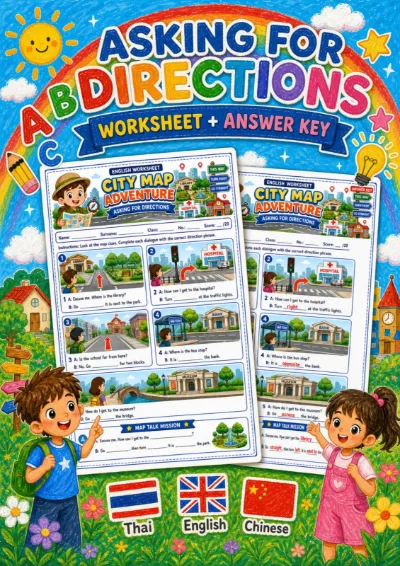
Grades 4–6 (P.4–P.6)
Asking for directions worksheet
19 Baht
View detailsEnglish
An AR classroom game for Grade 6. Learners can aim with their hands at the camera or play by tapping the screen.
This set has 4 rounds in an interactive ordering activity.
Curriculum indicatorต 1.3 ป.6/1
A look before you play
A few real prompts from the game to help you choose an activity for your class.
A letter opens with a greeting and ends with a sign-off and your name.
From broad to narrow: the name first, then the detail.
Subject, "have" or "has", participle, then the detail.
Before you play
Practise the shape of a letter or email to a friend: Dear to open, Your friend to close, a self-introduction paragraph, I have visited Japan, and the steps of writing an email, so pupils can write about themselves (ต 1.3 ป.6/1).
4 ordering questions - Dear Nan, > How are you? > See you soon. > Your friend, Fah - My name is Fah. > I am twelve. > I live in Chiang Mai. > I like reading. - I > have > visited > Japan - Write the subject line > Greet the reader > Write the body > Sign your name
Use before pupils write an email to a pen pal or classmate, 4 minutes in solo mode. - After item 1, point out that Dear is followed by a name and a comma - Items 2 and 4 make a ready writing frame; pupils follow them with their own details Play it linked to a class and the results go into the mark book.
- Item 1: placing See you soon. after the name or before How are you?, not seeing it as a closing line - Item 3: building I visited have Japan, not yet used to have + past participle - Item 2: swapping I am twelve. and I live in Chiang Mai., which reads fine either way
Grades 4–6 (P.4–P.6)
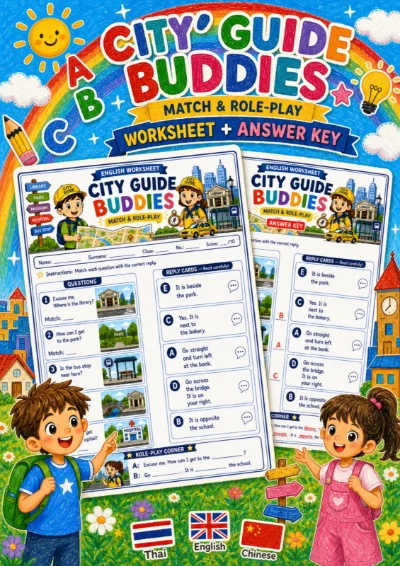
Grades 4–6 (P.4–P.6)
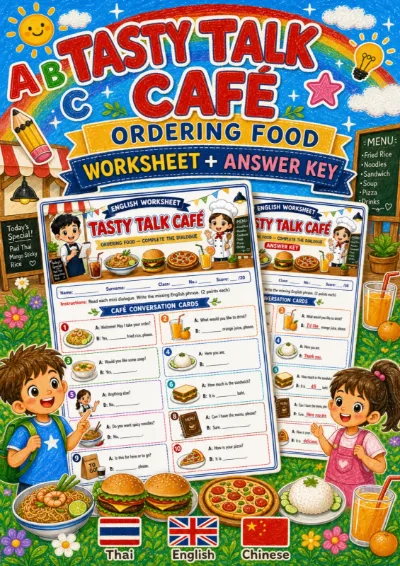
Grades 4–6 (P.4–P.6)

Grades 4–6 (P.4–P.6)
 Matching
EnglishGrade 14 rounds
 Multiple choice
EnglishGrade 16 questions
 Sorting
EnglishGrade 14 rounds
 Ordering
EnglishGrade 14 rounds