
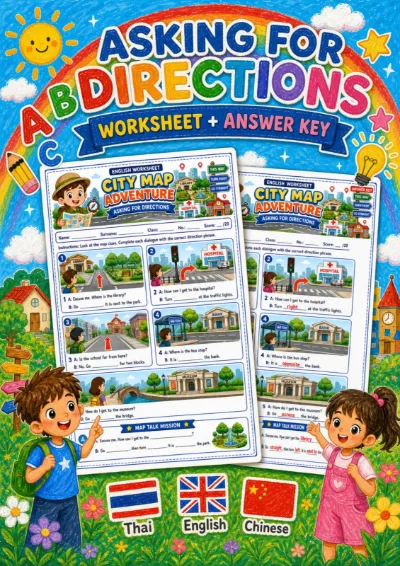
Grades 4–6 (P.4–P.6)
Asking for directions worksheet
19 Baht
View detailsEnglish
An AR classroom game for Grade 6. Learners can aim with their hands at the camera or play by tapping the screen.
This set has 6 questions in an interactive multiple choice activity.
Curriculum indicatorต 1.2 ป.6/1
A look before you play
A few real prompts from the game to help you choose an activity for your class.
With the present perfect and "for", the participle is "lived".
A present passive with a singular subject takes "is".
After "enjoy" the verb takes "ing".
Before you play
A second mixed P6 review: has lived with for, the present passive is read, enjoy + -ing, too heavy, Who to ask about a person, and will in an if sentence (ต 1.2 ป.6/1).
6 multiple-choice items - She has ___ in Bangkok for five years. (lived) - The book ___ read by many people. (is) - I enjoy ___ new languages. (learning) - This box is ___ heavy to carry. options too / enough / very much - ___ is the boy who won? options Whose / Who / Which
Use after the first P6 review set, or on another day, 5 minutes in team mode. - For has lived, have pupils say how long they have been at this school: I have studied here for ... years - For too heavy, lift a real bag and say It is too heavy to carry. Play it linked to a class and the results go into the mark book.
- She has ___ in Bangkok: choosing living because -ing feels familiar; has takes the past participle - ___ is the boy who won?: choosing Whose because who appears later in the sentence - The book ___ read: choosing are because of many people at the end
Grades 4–6 (P.4–P.6)
Grades 4–6 (P.4–P.6)

Grades 4–6 (P.4–P.6)

Grades 4–6 (P.4–P.6)
 Matching
EnglishGrade 14 rounds
 Multiple choice
EnglishGrade 16 questions
 Sorting
EnglishGrade 14 rounds
 Ordering
EnglishGrade 14 rounds