
Grades 4–6 (P.4–P.6)
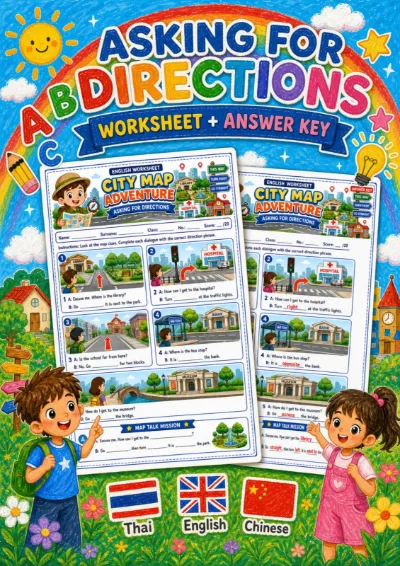
Asking for directions worksheet
19 Baht
View detailsEnglish
An AR classroom game for Grade 6. Learners can aim with their hands at the camera or play by tapping the screen.
This set has 6 questions in an interactive multiple choice activity.
Curriculum indicatorต 1.2 ป.6/1
A look before you play
A few real prompts from the game to help you choose an activity for your class.
The present perfect uses "have" or "has" with the past participle; "I" takes "have".
A third-person singular subject takes "has".
The participle of "go" is "gone"; "went" is the past and cannot follow "have".
Before you play
Practise a first look at the present perfect: have with I, they and we, has with she and he, participles often confused with the past form (gone, seen, lost), and words like already that go with it.
6 multiple-choice items - I ___ finished my homework. (have) - She ___ eaten lunch already. (has) - They have ___ to Chiang Mai. options go / went / gone - We have ___ this film before. options seen / see / saw - Which word goes with the present perfect: yesterday / already / last year
Use once pupils know the three verb forms, 5 minutes in solo mode. - Chart go went gone, see saw seen, lose lost lost and circle the third form - After item 4, ask Have you seen ...? with films pupils know; they answer Yes, I have. / No, I have not. Play it linked to a class and the results go into the mark book.
- They have ___ to Chiang Mai.: choosing went because it is past; after have use the third form, gone - We have ___ this film before.: choosing saw for the same reason - Item 5: choosing yesterday, thinking any past-time word fits
Grades 4–6 (P.4–P.6)
Grades 4–6 (P.4–P.6)

Grades 4–6 (P.4–P.6)

Grades 4–6 (P.4–P.6)
 Matching
EnglishGrade 14 rounds
 Multiple choice
EnglishGrade 16 questions
 Sorting
EnglishGrade 14 rounds
 Ordering
EnglishGrade 14 rounds