

A Grade 2 child has matched a picture of a cat to the word cat since Grade 1. Asked to read The cat is on the bed., she sounds out every word correctly and still cannot say where the cat is. She can read. She has never had to join several words into one meaning. Grade 2 English is the year single words have to become sentences.
This article shows where the Grade 2 indicators move beyond Grade 1, lays the topics out as a plan of about 18 weeks, and says which Grade 1 to 3 worksheets fit where. Your textbook may order units differently and you can swap them, but keep the principle that children hear and say a sentence before they meet it on paper.
How the Grade 2 indicators differ from Grade 1
Set the Grade 1 and Grade 2 indicators of the core curriculum side by side and most of the wording is the same. The few added words are the new content of the year.
- ต 1.1 ป.2/2 adds reading simple sentences to letters, sounds, reading aloud and spelling words. Grade 1 stops at words.
- ต 1.1 ป.2/3 asks children to choose the picture that matches words, phrases and sentences they hear. Grade 1 covers words and phrases only.
- ต 1.1 ป.2/1 adds simple requests to simple instructions, for example Please close the door.
- ต 1.2 ป.2/2 asks children to use simple instructions and requests themselves, not only follow them.
- ต 1.1 ป.2/4 asks children to answer questions after hearing sentences, dialogues or simple illustrated stories. Grade 1 answers questions about familiar topics.
Three versions per topic, and Grade 2 can move faster
Most Krufahda Grade 1 to 3 vocabulary worksheets come in three versions: version 1 matches pictures to words, version 2 fills in missing letters and picks the correct spelling, version 3 asks children to write the word from a picture. In Grade 1 version 2 usually waits until the second half of term. Grade 2 has spelling in its indicators, so version 2 can come at the end of the first week of each topic.
Keep version 3 for review or for early finishers, because recalling and writing a word is much harder than choosing the right spelling. If half the class gets less than half of version 2 right, version 3 is still too early.
All term: sentence reading, 10 minutes a day
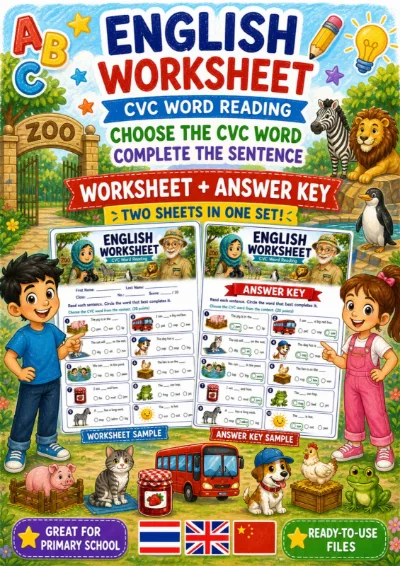
Sentence reading should not be a separate unit. Make it a warm-up every lesson. Start with three-sound words children can blend, such as cat sit hot, then join them into short sentences with the, is, on and in. Children must do something with the meaning, such as point to a picture, draw it, or say yes or no, not just read aloud to the end.
The CVC word reading worksheets come in three versions that step up neatly: read sentences and circle the word that fits, read a story and choose true or false, then read a short story and answer questions. All three are tagged to ต 1.1 ป.2/2 in the shop and can rotate weekly through the term.
Weeks 1 and 2: classroom language, now with requests
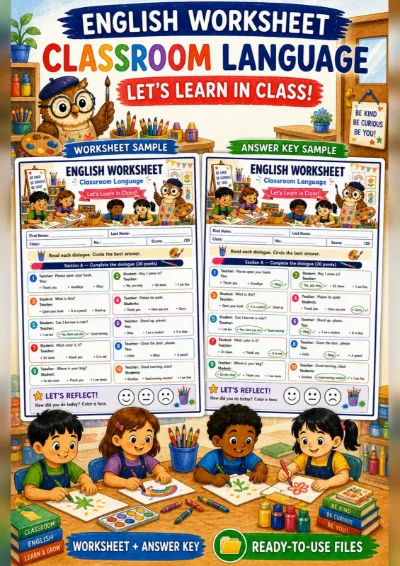
Open the term with the instructions children know from Grade 1, then add requests and asking permission: Please sit down. Can I go to the toilet? May I come in? Model them every lesson and have children ask before they leave their seat. Within two weeks the phrases become routine.
The classroom language worksheets, one where children read a dialogue and circle the answer and one where they match question cards to answers, are tagged to ต 4.1 ป.2/1 (listening and speaking in simple classroom situations) and close these two weeks well. If you want children to write instructions themselves, the imperatives fill-in worksheet follows on directly.
Weeks 3 to 6: food, drinks, fruit and vegetables
Food lets children say what they want (ต 1.2 ป.2/3) and use the requests that are new in Grade 2 in the same sentence. Use I want rice. Can I have some water, please? and run a classroom restaurant where children take turns selling and buying. Sentences said for real last longer than sentences copied into a notebook.
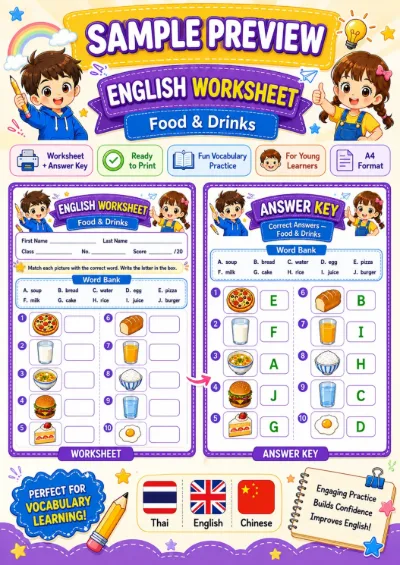
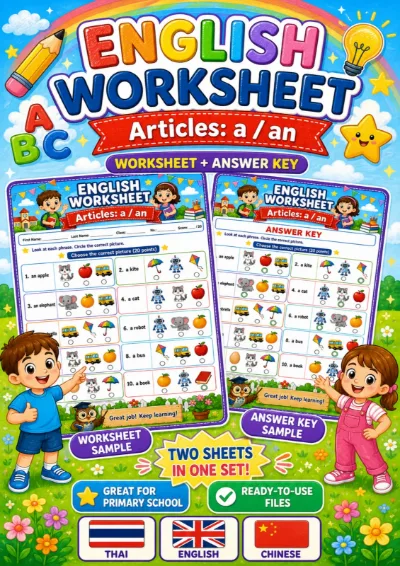
Use the food and drinks picture-word matching worksheet in the teaching week, then the missing-letters version. The fruit and vegetables worksheets work the same way over the next two weeks. Teach a and an alongside, since children meet an apple, an egg and an orange here. The a / an circle-the-answer worksheet, tagged to ต 1.1 ป.2/4, fits as a one-lesson break.
Weeks 7 to 9: clothes and weather, taught as a pair
These can be taught separately, but together they give Grade 2 children sentences with a reason in them: It's hot. I wear a hat. It's rainy. I wear a raincoat. Open every lesson with How's the weather today? and have one child answer at the front.
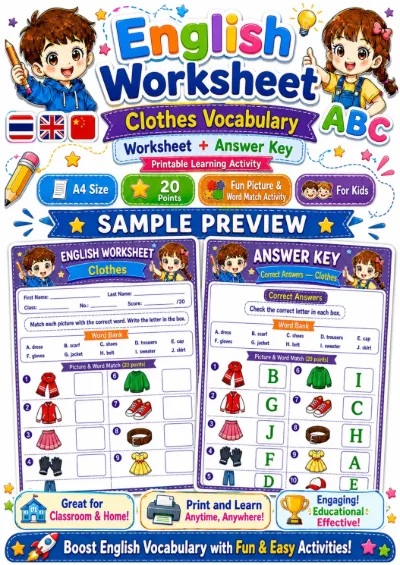
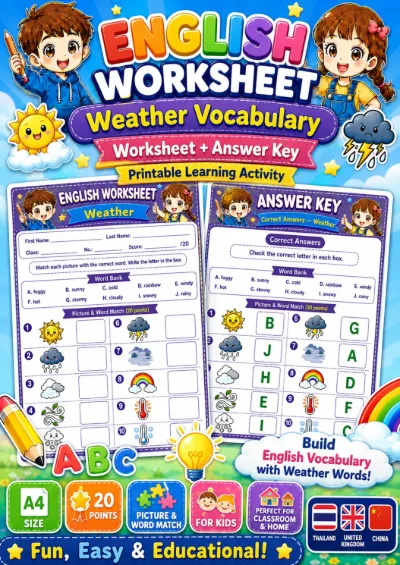
The clothes and weather picture-word matching worksheets are tagged to ต 1.1 ป.2/3, choosing pictures by meaning. Read a sentence aloud first and have children point to the picture before drawing the line, and a matching sheet becomes sentence listening practice too.
Weeks 10 to 12: school, days and routines
School words and days of the week pair with the class's real timetable: On Monday, we have English. Today is Tuesday. Put an English timetable beside the board and have the helper of the day read what day it is and which subjects are on.
Use versions 1 and 2 of the school and days of the week worksheets as usual. Version 3 of days of the week, writing the days in order and filling in missing days, suits the end of the unit, because Grade 2 children often misspell Wednesday even when they say it fluently.
Weeks 13 to 17: home, jobs and sport
The end of term turns to talking about themselves and people around them, matching ต 1.2 ป.2/4, asking for and giving simple information about themselves following a model. Use This is my bedroom. My mother is a nurse. I like football. Have children draw their home or family and say three sentences.
Worksheets for this stretch are house and rooms, basic jobs and sports. All three have a version 3 where children write the word that matches a number on a picture, for children who have passed version 2.
Week 18: review with picture stories
ต 1.1 ป.2/4 asks children to answer questions after listening to sentences, dialogues or simple illustrated stories, so the last week should include a short story read aloud followed by questions. The picture stories worksheets, circle the answer and true or false, work both for children reading alone and for the teacher reading aloud.
With a screen at the front, the AR set Grade 2 English review: is are has can has 6 questions and closes the term in five minutes. Matching and sorting sets such as food and drinks, clothes, and weather and seasons review one topic at a time during the term. Open a set before class, since some may include words your class has not met yet.
Common Grade 2 mistakes and what each one tells you
- Reads every word aloud but cannot say what the sentence means: decoding uses up all the effort. Read the same sentence twice, once to decode and once for meaning, then ask.
- a apple or a egg: the vowel-sound rule is not there yet. Listen to the first sound, not the first letter.
- two cat or three banana: Thai adds nothing to a noun for more than one. Hold up real objects and count, saying the s clearly.
- Answers every question with Yes or No: the child understands the question but has no answer sentence. Put Yes, I do. or It's ... on the board.
- Says the days correctly but spells them wrong: normal for words that are not written as they sound. Split Wed-nes-day for spelling, even though it is not said that way.
For parents at home
Grade 2 children gain more from reading short sentences together than from extra worksheets. Put one sentence on the fridge each morning, such as The milk is cold., and have your child read it and act on it or point to what it describes. If your child reads aloud correctly but cannot act on it, do not ask for more rereading. Ask what each word means, and tell the teacher where your child gets stuck.
Worksheets from this article
Grades 1–3 (P.1–P.3)
CVC Word Reading - Choose the Word from the Context
Grades 1–3 (P.1–P.3)
Classroom Language - Read the Classroom Dialogue and Circle the Best Reply
Grades 1–3 (P.1–P.3)
Food & Drinks - Match the Pictures and Words
Grades 1–3 (P.1–P.3)
Articles a / an - Circle a or an
Grades 1–3 (P.1–P.3)
Clothes - Match the Pictures and Words
Grades 1–3 (P.1–P.3)