

A teacher asks a Grade 5 child, Do you like durian? The child says Yes. Why? Because delicious. The meaning is fine, and much better than silence, but the Grade 5 indicators ask for more. Children must say and write how they feel with a short reason that is a sentence: Because it is sweet. or I like it because it smells good.
Grade 5 English is the year short answers stop being enough. Children must find the main idea, give reasons, and notice that English word order differs from Thai. This article shows what the Grade 5 indicators add to Grade 4, lays out about 18 weeks using Grade 4 to 6 worksheets, and lists the common mistakes. Adjust the unit order to your textbook.
What the Grade 5 indicators add to Grade 4
The Grade 4 and Grade 5 indicators in the core curriculum are worded very similarly. The differences are a few phrases, and those phrases decide what Grade 5 must add.
- ต 1.1 ป.5/4: state the main idea and answer questions after listening to and reading dialogues, simple stories or short texts. Main idea appears for the first time.
- ต 1.2 ป.5/5: speak or write about one's feelings on familiar topics and activities, with short reasons. Grade 4 speaks following a model; Grade 5 must write as well, with reasons.
- ต 1.2 ป.5/3: express needs, ask for help, and accept or refuse offers of help. Accepting and refusing are new.
- ต 1.2 ป.5/2: use instructions, requests, asking permission and simple advice. Giving advice is new.
- ต 1.3 ป.5/2: draw pictures, diagrams and charts showing information heard or read. Grade 4 speaks or draws; Grade 5 organises information into diagrams or charts.
- ต 2.2 ป.5/1: say how sentence intonation, punctuation and word order are alike or different in English and Thai. Children must see that English orders words differently.
Using Grade 4 to 6 worksheets in Grade 5
Most Krufahda Grade 4 to 6 grammar worksheets have three steps: version 1 looks at a picture and chooses the right sentence or word, version 2 fills in words, version 3 orders word cards into a sentence and writes it. Versions 1 and 2 of many topics are tagged in the shop to ต 1.1 ป.5/3, identifying pictures or symbols that match the meaning of sentences.
In Grade 5, version 3 should not be optional, because ordering words is where ต 2.2 ป.5/1 on word order actually happens. Whenever a child orders words wrongly, ask how it would go in Thai. The child sees for themselves that they followed Thai order.
All term: main-idea reading every two weeks, then a chart
The comprehension passages and main idea and details worksheets, multiple choice and true or false, are tagged to ต 1.1 ป.5/4 in the shop. They include Leo's garden project, Mia's rainy picnic, The Park Team and Maya's Library Day, and can rotate every two weeks through the term.
Before children answer the questions, have them write the main idea in one sentence, then answer the details. A child who gets every detail right but cannot write the main idea is reading for answers in spots without seeing the whole text. After reading, have children turn the text into a short table or diagram, who did what and where, which matches ต 1.3 ป.5/2.
Weeks 1 and 2: check the present tenses before moving on
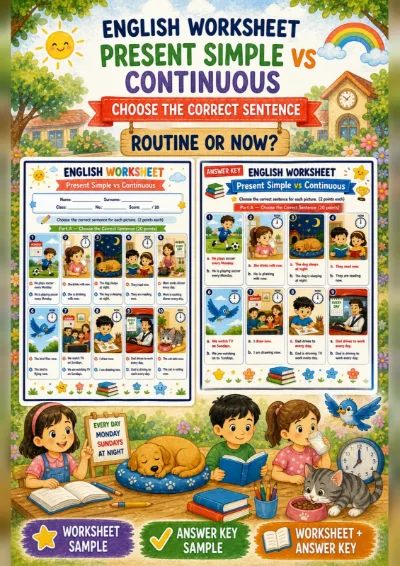
Most Grade 5 classes met Present Simple and Present Continuous in Grade 4, so the first two weeks do not reteach them. Use them to check whether children really tell the two apart. The Present Simple vs Continuous choose-the-sentence worksheet and the adverbs of frequency worksheet, where children read a frequency bar and choose the word, make a short check.
If more than half the class picks the wrong tense, reteach the time words that signal tense, every day, usually, now, at the moment, before the past unit, because the next unit adds a third tense.
Weeks 3 to 6: telling what happened
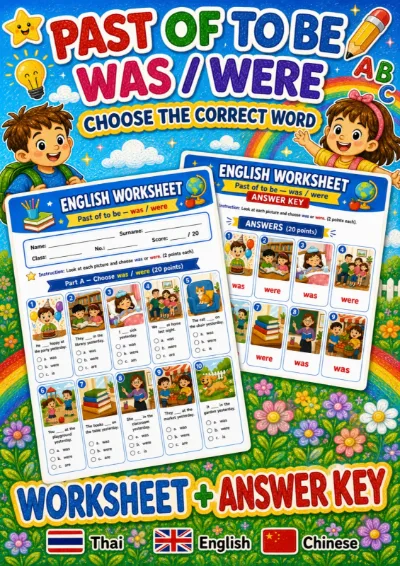
Order was and were before regular verbs, then irregular verbs, using the Past of to be, Past Simple regular and Past Simple irregular worksheets in that order. The reasons for this order are in our Grade 4 to 6 English worksheets article.
What Grade 5 adds is telling events in sequence. After the unit, have children describe their holiday in four sentences with First, Then, After that, Finally. The AR set ordering a past story, where children put sentences into a story, works as a whole-class model before children write their own.
Weeks 7 to 9: describing and comparing, in a different word order
This is where ต 2.2 ป.5/1 shows most clearly. Thai says รถสีแดงคันใหญ่, English says a big red car, adjectives before the noun. Thai learners often write a car red. Write the Thai and English sentences side by side on the board and draw lines between matching words. Children see where the lines cross.
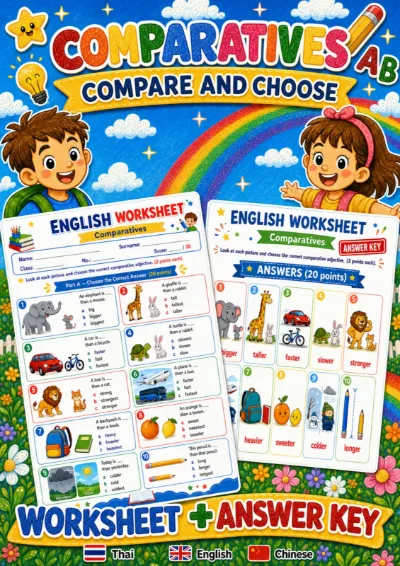
Use the adjectives picture-word matching sheet, then the comparatives and superlatives choose and fill versions, which are tagged to ต 1.1 ป.5/3 in the shop. Close with the word-card version that builds comparison sentences. The AR sets on adjective order and comparing two things work as lesson warm-ups.
Weeks 10 to 12: food, shopping and asking for help
Restaurant and shop situations combine several new Grade 5 indicators: saying what you want, asking for help, and accepting or refusing an offer. Can I help you? Yes, please. I'm looking for a bag. No, thank you. I'm just looking. Have pairs role-play before every worksheet.
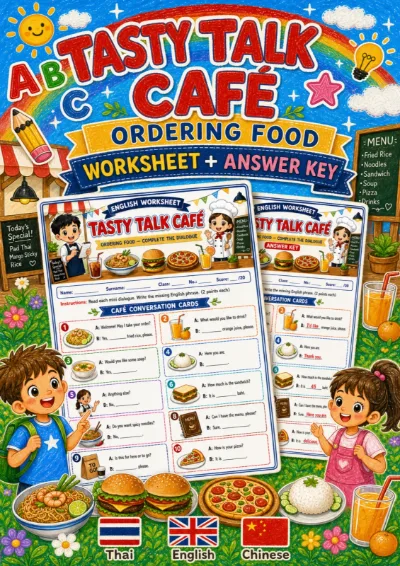
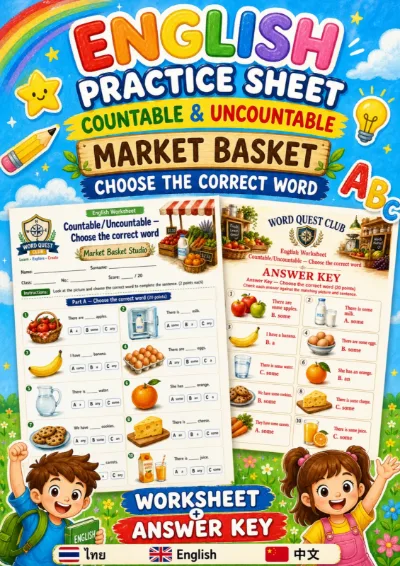
The ordering food worksheet, where children fill missing phrases in a dialogue, is tagged to ต 1.2 ป.5/3. The shopping worksheet, where children circle the customer's and the assistant's answers, is tagged to ต 1.2 ป.5/1. The grammar needed is countable and uncountable nouns and the quantifiers some, any, much, many, each with choose and fill versions.
Weeks 13 and 14: whose is it
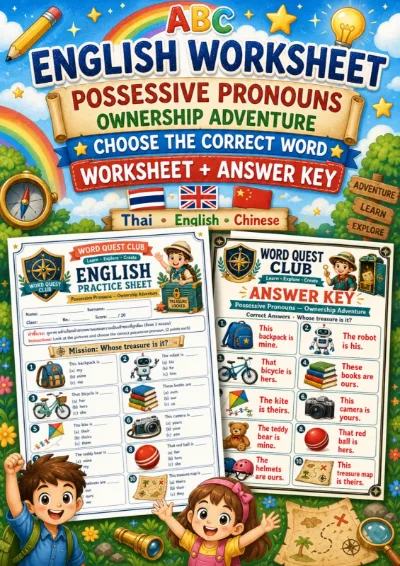
Possessive pronouns mine, yours, his, hers, ours, theirs and object pronouns me, him, her, us, them let children speak without repeating the noun: Is this your pencil? No, it isn't mine. It's hers. Use real objects. Collect pens from five desks in a box and have children find the owners with these sentences.
The possessive pronouns and object pronouns worksheets, choose and fill versions, are tagged to ต 1.1 ป.5/3 in the shop.
Weeks 15 and 16: time and timetables
at, on and in are small words children confuse through primary school. Teach them as three levels: at with clock times, on with days, in with months, years and parts of the day. Then use the class timetable: We have English on Monday at nine o'clock. The prepositions of time choose and fill worksheets are tagged to ต 1.1 ป.5/3 in the shop, and the telling time past and to worksheets follow in the same unit.
Weeks 17 and 18: giving reasons, then review
End the term with the problem from the opening. The conjunctions worksheet, circle and, but or because, leads children to sentences with reasons, followed by the opinion sentences worksheet, completing I think, I like and because. The shop tags both to Grade 6 indicators, but the content fits ต 1.2 ป.5/5, feelings with short reasons, and works in Grade 5.
With a screen at the front, the AR sets Grade 5 English review: past tense and comparatives and Grade 5 English review: must, past tense, There is each review in five minutes. The second includes must, which this plan does not place, so check it first.
Common Grade 5 mistakes and what each one tells you
- Because delicious.: the child knows a reason is needed but uses because in place of a sentence. Make it a rule that because is followed by a subject and a verb: Because it is delicious.
- a car red or a bag big: Thai word order. Write both languages side by side and draw lines between matching words.
- more bigger: two methods at once. Count the syllables before choosing -er or more.
- two rices or many water: countable and uncountable are not separate yet. Ask whether it can be counted piece by piece; if not, use a unit, a bowl of rice, a glass of water.
- It's my. or This book is me.: the two possessive sets are mixed. Stress that my needs a noun after it and mine stands alone.
- at Monday or in seven o'clock: prepositions learned word by word, not as a rule. Go back to the three levels from week 15.
End-of-unit check: three sentences with a reason
Multiple-choice worksheets show that children know a rule, but the Grade 5 indicators ask them to write on their own and give reasons. At the end of each unit, have children write three sentences about themselves using the new structure, with because in at least one: My bag is bigger than my brother's because I have more books. You can read the whole class in a few minutes and see grammar, word order and reasoning in one piece of work.
For parents at home
Grade 5 children need practice giving reasons in English. Ask one either-or question a day, such as Rice or noodles?, and have your child answer with one reason. If the answer is just Because yummy, ask What is yummy? Your child will add the subject, The noodles are yummy., without being taught the rule.
Worksheets from this article
Grades 4–6 (P.4–P.6)
Present Simple vs Continuous worksheet
Grades 4–6 (P.4–P.6)
Past of to be worksheet
Grades 4–6 (P.4–P.6)
Comparatives - Look at the Picture and Choose Bigger, Taller or Faster
Grades 4–6 (P.4–P.6)
Ordering food worksheet
Grades 4–6 (P.4–P.6)
Countable & Uncountable Nouns - Look and Choose a, an, some or any
Grades 4–6 (P.4–P.6)