

Ask Grade 4 children whether fire is alive and many say yes, because fire moves, grows and eats fuel. They are not guessing. They are using a rule they built in Grade 1, and nobody has checked whether it still works. Primary science is not only about adding new knowledge each year. It is also about going back to repair old understanding.
The Thai core curriculum, revised in 2017 (B.E. 2560), divides science into biological science, physical science, and earth and space science. The same topic often returns several times in later grades, deeper each time. Krufahda's science worksheets are written at a basic level, such as circling, filling in and labelling, so they work in two ways: for teaching and practice in Grades 1 to 3, and for checking prior knowledge before a unit in Grades 4 to 6. The grades named here follow the IPST (สสวท.) textbooks in general; schools using other textbooks may order topics differently.
Start the year with safety, whatever the grade
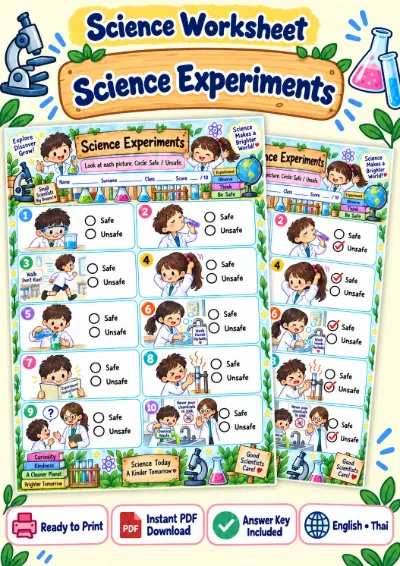
Before the first experiment of the year, use the Science Experiments worksheet, circling safe or unsafe, then have the class agree three lab rules together and post them at the front of the room. Children remember rules they made better than rules read to them.
Biological science: living things, plants, animals and the body
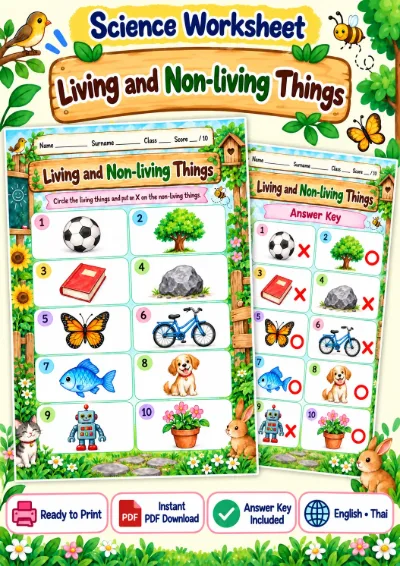
Living and Non-living Things, circling and crossing, is where the fire misconception starts. Children often use movement as the only test, so they class cars, fire or the sun as living and seeds as non-living. Have them check several features together, such as needing food, breathing, growing and reproducing. If not all are there, they cannot conclude yet.
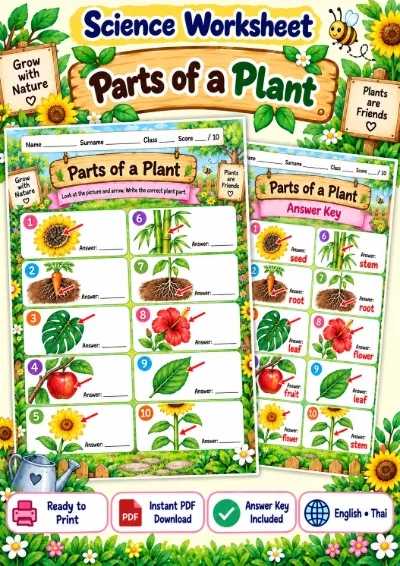
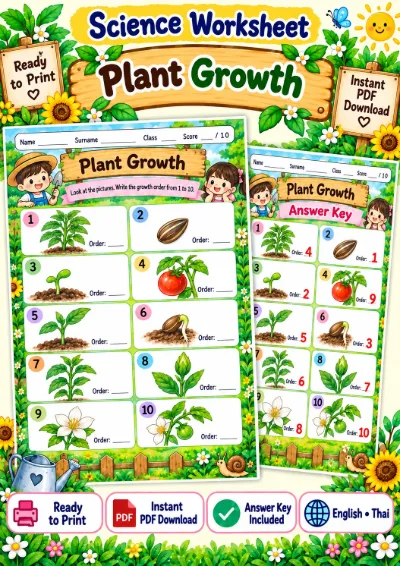
Plants come back again and again. Parts of a Plant, labelling the parts, works from Grade 1, when children learn the names, and again in Grade 4, when they learn what roots, stems, leaves and flowers do. Plant Growth, ordering the stages, fits Grade 2, which covers what plants need, water and light, and the life cycle of flowering plants.
Animal Life Cycles, naming the stage, fits Grade 3. Body and Senses, naming the sense organ, works from Grade 1 and lays the ground for body systems in later grades. For food chains, which sit in Grade 5, the teaching media Forest Explorers: Food Chains can open the unit.
Physical science: materials, matter, forces and energy
Materials Around Us and Properties of Materials are a pair. Grade 1 starts with what an object is made of, and Grades 2 and 4 continue with properties such as hardness, elasticity and heat conduction. Solids, Liquids and Gases, naming the state, fits Grade 4. The usual sticking point is believing gas is not matter because you cannot see it. Blow up a balloon and ask what is inside: does it take up space and have mass?
Magnets, attracted or not, fits Grade 3. The common misconception is that magnets attract every metal. In fact they attract only some, such as iron, and not aluminium or copper. Let children test an aluminium can and a real paper clip before writing answers. Sound, naming the sound source, can open the Grade 5 sound unit. Have children touch their throat while speaking and feel the vibration, the core idea that sound comes from vibrating objects.
Basic Electricity, circling whether something uses electricity, lays the ground for electrical energy in Grade 3 and simple circuits in Grade 6. Follow up by asking what kind of energy each appliance turns electricity into.
Earth and space: the sky, the solar system, soil and rocks
Earth, Sun and Moon supports day and night in Grade 3 and the Moon in Grade 4. Two misconceptions to check: that day and night happen because the Sun moves around the Earth, and that the Moon makes its own light. In fact day and night come from the Earth spinning on its axis, and the Moon reflects sunlight. A torch and a ball in a darkened room demonstrate this in five minutes.
The Solar System fits Grade 4. Soil fits Grade 2, which covers what soil is made of and its types. Have children look at soil from the school field with a magnifying glass alongside it. Rocks and Minerals works in Grade 1, which looks at the outside features of rocks, and as a prior-knowledge check before igneous, sedimentary and metamorphic rocks in Grade 6.
Using basic sheets to check prior knowledge in Grades 4 to 6
Grade 4 to 6 teachers may think circle-the-answer sheets are too easy for older children. That ease is the advantage when opening a unit: children finish in five minutes and you see the misconceptions before you start teaching. There are three steps.
- Hand out a sheet on a topic children have met before, such as Solids, Liquids and Gases before the states of matter unit. Children work alone, and it is not marked
- Ask children to write a short reason next to any answer they are unsure of. Reasons tell you more than answers. A child who writes that steam is not a gas because you can see it is confusing water vapour with the tiny water droplets that float as white mist
- Turn the errors many children share into the opening question of the unit, instead of starting with definitions
Every worksheet follows the real thing, it does not replace it
Science worksheets work best when children observe the real thing first, even for five minutes: pull up a weed to look at the roots before Parts of a Plant, or try a magnet on things in the pencil case before the Magnets sheet. The worksheet then organises what children have just seen, instead of asking them to memorise answers from drawings.
Every science worksheet comes with Thai instructions and English instructions, so EP and MEP classes can use the same set as regular classes.
For parents at home
The best science question is why do you think so? If your child says the Moon shines by itself, do not correct them straight away. Ask how they know, then watch the Moon together over several nights. They will see its shape change, which is a good starting point for learning about the Moon at school.
Worksheets from this article
Grades 1–3 (P.1–P.3)
Science Experiments - Circle Safe or Unsafe
Grades 1–3 (P.1–P.3)
Living and Non-living Things - Circle and Cross
Grades 1–3 (P.1–P.3)
Parts of a Plant - Label the Plant Parts
Grades 1–3 (P.1–P.3)
Plant Growth - Order the Stages
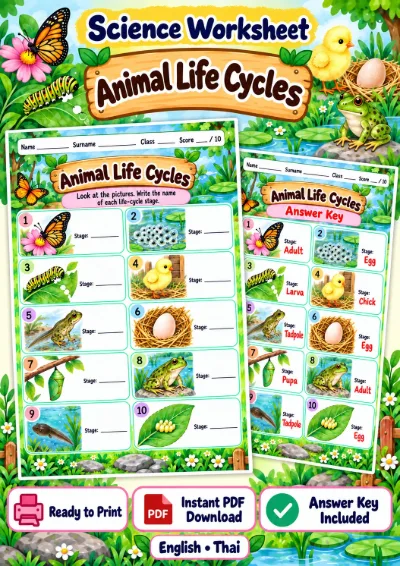
Grades 1–3 (P.1–P.3)
Animal Life Cycles - Name the Stage
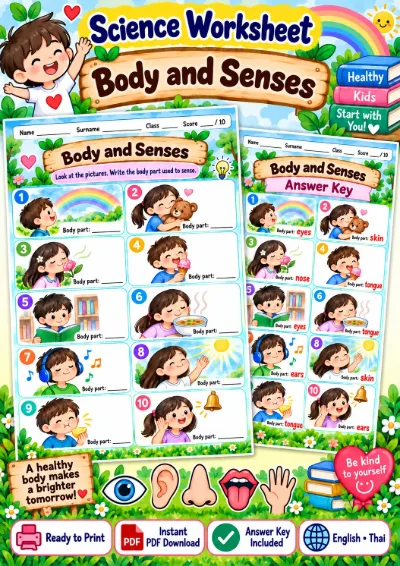
Grades 1–3 (P.1–P.3)