
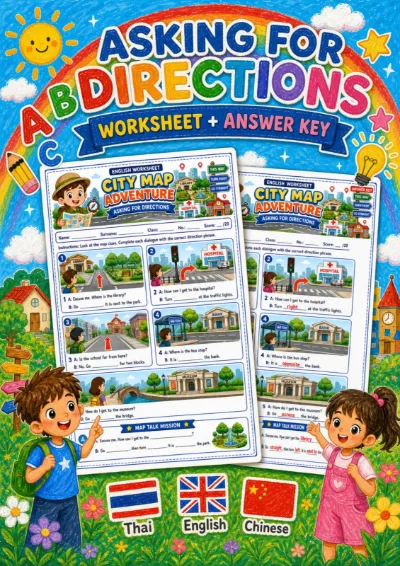
Grades 4–6 (P.4–P.6)
Asking for directions worksheet
19 Baht
View detailsEnglish
An AR classroom game for Grade 4. Learners can aim with their hands at the camera or play by tapping the screen.
This set has 4 rounds in an interactive sorting activity.
Curriculum indicatorต 1.2 ป.4/1
A look before you play
A few real prompts from the game to help you choose an activity for your class.
Sort into
Look at the verb form and the time word.
Sort into
Regular verbs add "ed"; irregular verbs change shape.
Sort into
Separate school subjects from places in school.
Before you play
Sort present vs past sentences, regular -ed verbs vs irregular past forms (went, ate), Do/Does vs Did questions, and school subjects vs places in school (indicator ต 1.2 ป.4/1).
4 questions, sorting into 2 groups - I eat rice. is present; I ate rice. is past - walked, played add ed; went, ate change form - Maths, Science are subjects; library, canteen are places - Does she go? asks about the present; Did she go? about the past
Use after first teaching the past simple, about 5 minutes, solo. Q1 and Q4 put sentences side by side that differ by one word; have children point to the changed word before dragging. - For Q2, the class says the present form of every verb: walk, play, go, eat - Play it linked to your class so scores go into the gradebook
- I ate rice. (Q1): dragged to present by children who do not know ate is the past of eat - went (Q2): some do not know it comes from go, so they are unsure it changes form - Did she go? (Q4): hesitation because go looks present. Stress that Did already marks the past
Grades 4–6 (P.4–P.6)
Grades 4–6 (P.4–P.6)
Grades 4–6 (P.4–P.6)

Grades 4–6 (P.4–P.6)
 Matching
EnglishGrade 14 rounds
 Multiple choice
EnglishGrade 16 questions
 Sorting
EnglishGrade 14 rounds
 Ordering
EnglishGrade 14 rounds