

Many Grade 1 teachers open the term with an A to Z tracing sheet, while some children still cannot hold a pencil steadily and have never heard the word pencil in class. The result is beautifully copied letters, and a silent room when the teacher holds up a pencil and asks What is this? In Grade 1, the ear and the mouth have to come before the pencil.
The Thai core curriculum sets Grade 1 goals around listening to and following simple instructions, knowing letters and their sounds, and answering with short words following a model. This article splits Grade 1 content into four strands, lays them out as a plan of about 18 weeks, and says when each worksheet fits. Your textbook may order units differently, and you can swap units, but keep the principle of speaking before writing.
What Grade 1 really covers: four strands
The curriculum sets a cumulative vocabulary of roughly 300 to 450 words across Grades 1 to 3, so there is no need to rush the word count in Grade 1. Words children actually use in class are worth more than words they can recite but never say. Grade 1 content falls into four strands.
- Classroom language and greetings: the instructions the teacher gives every day, greetings, saying your name and age
- Letters and sounds: letter names, initial sounds, and tracing letters
- Concrete everyday vocabulary: numbers, colours, shapes, classroom objects, family, body parts, animals and toys
- Short sentence frames children can repeat: This is a ... / I see a ... / I have ... / It's red. No grammar teaching yet, just frames children can fill with their own words
Each topic has three worksheet types: match them to the moment
Most Krufahda Grade 1 to 3 vocabulary topics come in three versions. Version 1 matches pictures to words, version 2 fills in missing letters and picks the correct spelling, and version 3 asks children to write the word from a picture. They get harder in that order, because recognising a word you see is much easier than recalling it yourself.
In Grade 1, use version 1 in the week you teach the topic, after children can say the words. Use version 2 once children know initial sounds, usually in the second half of the term. Keep version 3 for end-of-term review or for fast finishers. Give version 3 to a whole Grade 1 class in the first week of a topic and you will collect more copying from neighbours than learning.
Weeks 1 to 3: classroom language and greetings
Start the term with language used every day: Stand up. Sit down. Open your book. Listen. Hello. Goodbye. What's your name? My name is ... Say them with actions every lesson until children respond without translation. Once these instructions are familiar, you can use more English in class for the rest of the term.
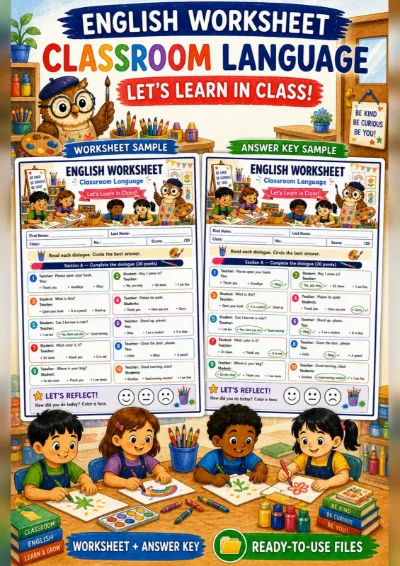
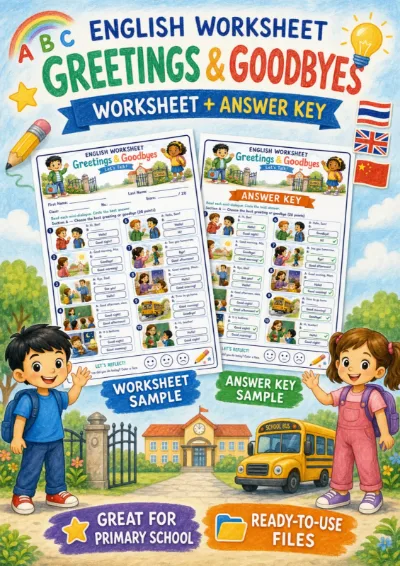
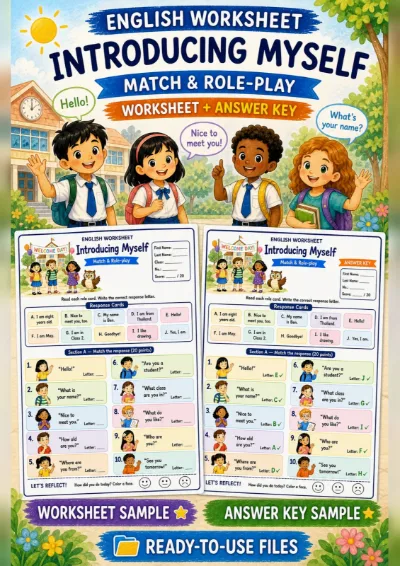
The Classroom Language, Greetings and Goodbyes, and Introducing Myself worksheets are short dialogues where children circle an answer or match a question to a reply. Most Grade 1 children cannot read the dialogue on their own early in the term, so read it aloud line by line, have the class repeat, and then let them circle. The worksheet becomes listening and speaking practice, not a reading test.
All term: letters and sounds, 5 to 10 minutes a day
Letters should not be a unit you finish in two weeks. Make them a short warm-up every lesson all term. Children need two things together: the letter name, such as A, B, C, and the sound it stands for, such as the a in apple or the c in cat. Teach only names and a child will read cat as see-ay-tee and have no idea what it means.
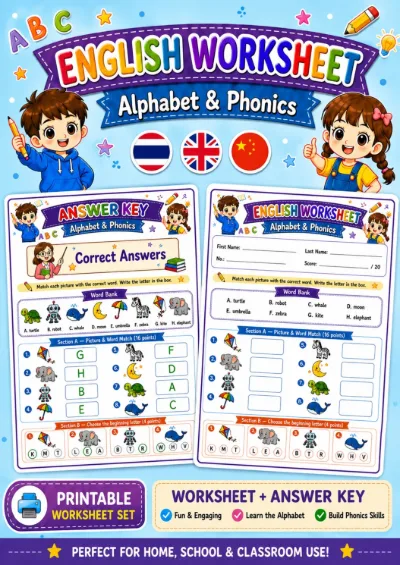
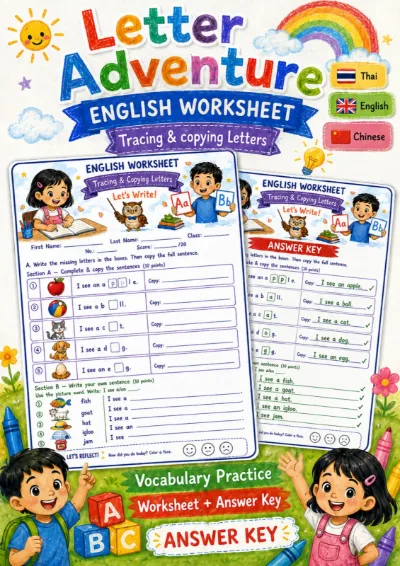
Many phonics programmes start with the group s a t p i n because these letters quickly blend into words such as sat, pin and tip. If your textbook uses another order, follow it. The Alphabet and Phonics matching worksheet practises initial sounds, and the Tracing and Copying Letters worksheet trains the hand and leads to a first sentence, I see a ..., by mid-term.
Weeks 4 to 8: numbers, colours and shapes
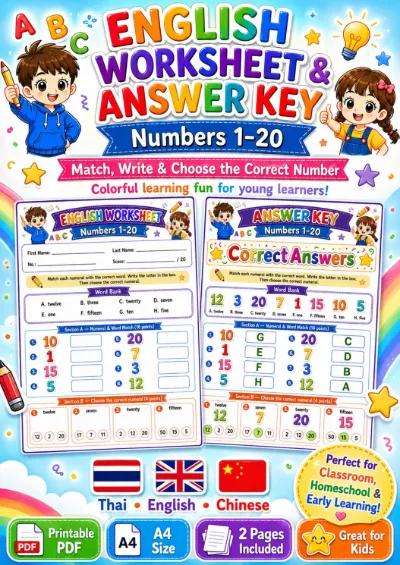
These topics are words you can point to, hold and count, which makes them ideal early in the term. Make 1 to 10 fluent before moving on to 11 to 20. Eleven, twelve and the teen numbers take longer, because they are not built as simply as Thai number words. Colours and shapes can be taught together: hold up a paper shape and ask What colour? What shape? Children answer It's red. It's a circle.
Use the Numbers 1-20 worksheet matching numbers to words, the Colours worksheet matching colours to words, and the Shapes worksheet matching shapes to words, once children can say the words. Shapes also pairs with Grade 1 maths, where children already learn triangles, rectangles and circles.
Weeks 9 to 13: classroom objects, family and body parts
Classroom objects can be used the moment you finish teaching them: Take out your pencil. Give me the eraser, please. Keep using them in your instructions every lesson afterwards. Family uses the frame This is my ... with children's own photos or drawings. Body parts work well with the song Head, Shoulders, Knees and Toes, followed by the sentence I have two eyes.
Worksheets for this stretch are Classroom Objects matching pictures to words, Family matching family members to words, and Body Parts matching pictures to words and choosing the initial letter. The body parts sheet includes initial-letter choices, so it links neatly to the daily initial-sound practice.
Weeks 14 to 17: animals, toys and polite words
Animals and toys are Grade 1 favourites, which suits the point in the term when children start to tire. Use the frames I like ... and I have a ... so children talk about their own pets or toys, then add polite language, Please. Thank you. You're welcome., in borrowing and sharing situations.
Use the Animals worksheet matching animals to words, the Toys worksheet matching pictures to words and choosing the initial letter, and the Please and Thank You worksheet matching situations to polite responses. For the polite-language sheet, read the situations aloud as you did at the start of term, and let children act out a short role-play before they match.
Week 18: review, and work for fast finishers
In the last week, use version 2 of topics already taught, such as colours or animals, to see whether children really know initial sounds. Most Grade 1 classes have a group who can already read short words. Give them the Word Writing worksheet, which traces sun, kite, book, frog and cake and then asks children to write words from pictures, or the CVC Word Reading worksheet where they read sentences and circle the word that fits.
Work for fast finishers should extend, not multiply. A child who finishes a matching sheet five minutes early gains nothing from another matching sheet.
Common Grade 1 mistakes and what each one tells you
Most Grade 1 mistakes are normal for the age. What matters is which step each mistake points back to.
- Writing b and d, or p and q, the wrong way round: very common at this age. Practise tracing while saying the direction of each stroke, no need to worry
- Reading words by letter names, such as cat as see-ay-tee: the child does not yet know letter sounds. Spend more time on initial-sound activities
- Mixing in Thai, such as It's สีแดง: the child has the sentence frame but cannot recall the word. Repeat the correct sentence, It's red., and have the child say it, without saying it was wrong
- Worksheet all correct, but the child cannot say the words: they matched by the shape of the word without knowing the sound. Go back to speaking activities before handing out the next topic's sheet
- Can sing the whole song but points to the wrong body part: they remember the tune, not the meaning. Stop the song midway and check one word at a time
For parents at home
A Grade 1 child does not need extra English worksheets every day. What helps more is a guessing game around the house with words they have learned, such as pointing to a red cup and asking What colour?, or counting the stairs in English. If your child brings a worksheet home, ask them to read the words to you first. If they cannot read them but match correctly, they recognise the shape of the words but not the sounds yet, which is worth telling the teacher.
Worksheets from this article
Grades 1–3 (P.1–P.3)
Classroom Language - Read the Classroom Dialogue and Circle the Best Reply
Grades 1–3 (P.1–P.3)
Greetings & Goodbyes - Read the Mini-Dialogue and Circle the Right Greeting
Grades 1–3 (P.1–P.3)
Introducing Myself - Match the Question Card to the Right Answer
Grades 1–3 (P.1–P.3)
Alphabet & Phonics - Picture and Word Match
Grades 1–3 (P.1–P.3)
Tracing & Copying Letters - Complete the Letters, Copy I See a Sentences and Write Your Own
Grades 1–3 (P.1–P.3)